 Santorini Island Guide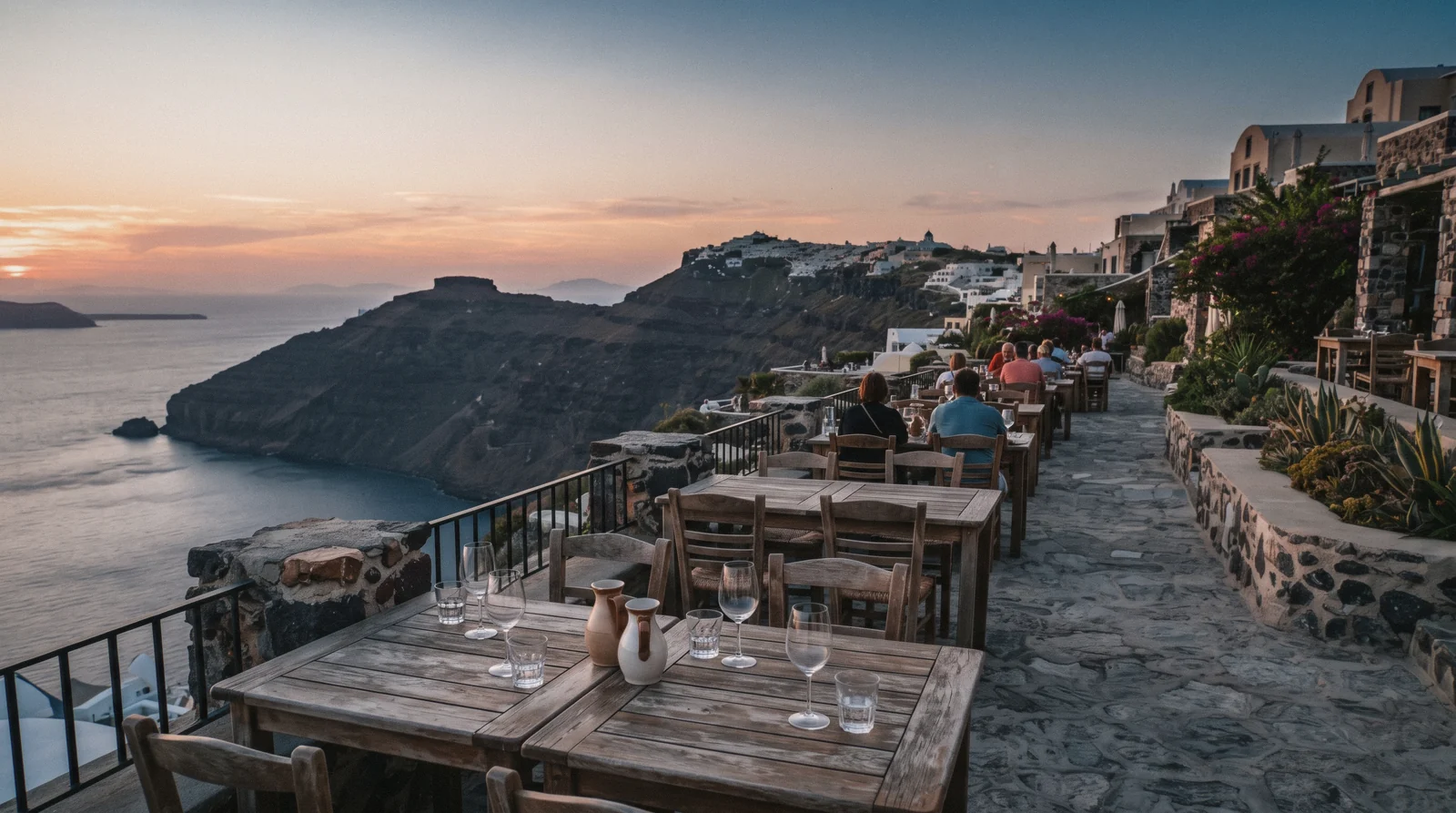
Santo Wines is the wine-tourism centre of the Santorini union of cooperatives, set on the caldera rim above Pyrgos. It is the biggest single tasting venue on the island, which means space, a proper terrace and a view straight down the caldera edge. This page covers the practical visit, and links out to the wider picture of Santorini wineries if you want to compare it with the small estates. It is part of our Santorini, Greece travel guide.
Quick answer Santo Wines in one answer
Santo Wines is the winery and Oenotourism Center of the Santorini cooperative union, on the caldera rim at Pyrgos. It is open all year and books online through santowines.gr. Tasting prices are listed on the winery's own booking page rather than published as a fixed tariff. The easiest way to include it without a car is a guided wine tour with pick-up.
Key takeaways
- Tastings happen on a caldera-edge terrace, and the venue is open all year. See Santorini wineries for how it compares.
- Coming from Fira without a car, take the KTEL bus towards Pyrgos for $2.46 (€2.20) or join a guided tour.
- The small-group sunset wine tour that ends at Santo Winery is our pick if you want the terrace at golden hour without driving.
Key facts
Opening hours
| All year | not stated–not stated |
|---|
Closed Not stated. The winery describes itself as open all year. Check santowines.gr before you go.
Admission
- Adult
- Tasting prices not stated here. They are listed on the winery's booking page.
- Reduced
- not stated
- Free
- not stated
Planning it
- Time needed
- Not stated officially. Our routing: 1 to 2 hours for a tasting on the terrace, longer if you stay for the sunset.
- Book ahead
- Recommended — a few days
- Address
- Pyrgos, Santorini, Greece (caldera side of the village)
What a visit to Santo Wines costs
A walk-in tasting at Santo Wines is bought directly from the winery, whose prices we do not reproduce here because they sit on its own booking page. What we can compare are the guided wine tours that include Santo Wines or end there, with their listed platform prices, durations and inclusions.
Do you want Santo Wines as one stop among three wineries, or as the final stop where you watch the sunset?
| Option | Price | Length | Includes | Book |
|---|---|---|---|---|
| Small-Group Sunset Wine Tour with Santo WineryAnyone who wants Santo Wines as the grand finale at sunset | $201.80 as listed | 4 - 4.5 hours | A small-group sunset tour that ends on the Santo Wines terrace | Check Availability |
| Santorini Wine Adventure with 12 Wine Tastings, Tapas and SunsetFirst-time visitors who want the widest tasting in one afternoon | $194.49 as listed | 4 hours | Three wineries, 12 wines, local cheese and snacks, Mercedes van with hotel pick-up, up to 15 guests | Check Availability |
| Santorini Wine Stories: Sunset Tour with Tasting & DinnerCouples who want a small group and a sit-down dinner after the tastings | $197.92 as listed | 5 hours | Tastings, snacks, dinner and bottled water, up to 8 guests | Check Availability |
| Wine Tasting Tour with SnacksVisitors who want a mid-price four-hour tasting with snacks | $190.59 as listed | 4 hours | Four-hour tasting tour with snacks, pick-up available, private option | Check Availability |
| Santorini 3-Winery Tour with 12 Wine Tastings and Oia SunsetTravellers who want three wineries plus the Oia sunset instead | $171.61 as listed | 4.5 hours | Three wineries, 12 tastings, snacks, Oia sunset, Mercedes Vito | Check Availability |
| Santorini Wine Tour: Visit 3 Local Wineries with TastingsBudget travellers who still want a guided three-winery afternoon | $143.01 as listed | 3.5 hours | Venetsanos, Roussos and a third winery, snacks, pick-up from meeting points | Check Availability |
The winery's own walk-in tasting tariffs are published on santowines.gr and are not repeated here. Tour prices are the platforms' own listings in dollars. Figures current in Q4 2026.
Wine tours that include Santo Wines
These are the wine tours on our books that feature Santo Wines or end on its terrace. Prices are as listed on the booking platform.
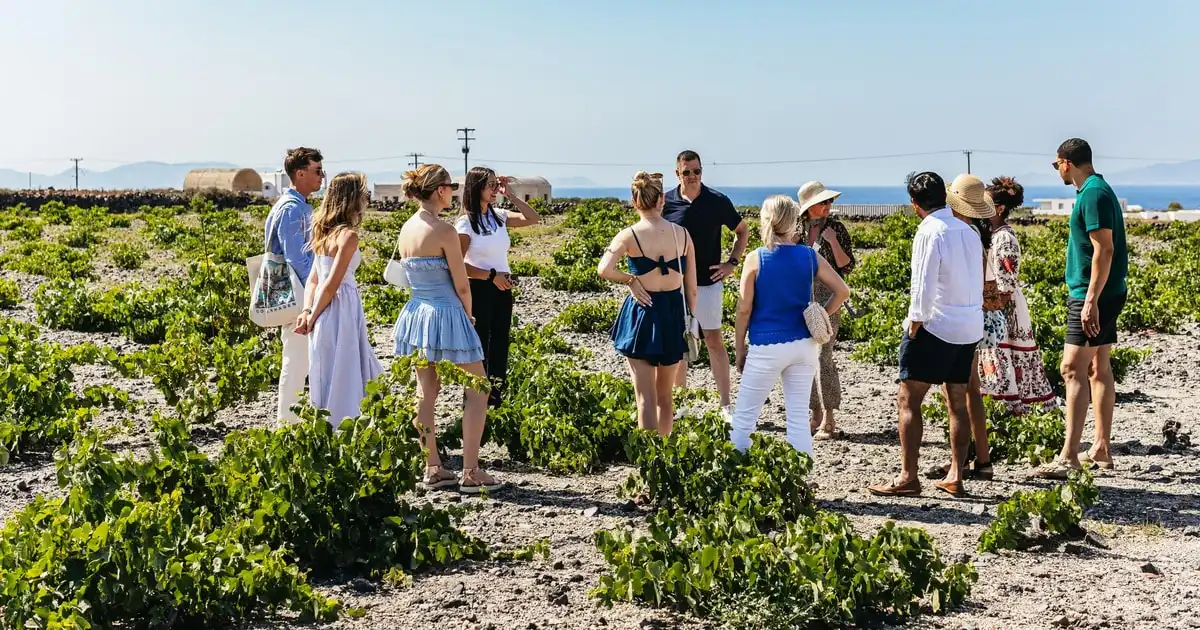 from $201.80
Small-Group Sunset Wine Tour with Santo Winery
A small-group sunset wine tour that ends on the Santo Wines terrace, four to four and a half hours.
Check Availability from $194.49
Santorini Wine Adventure with 12 Wine Tastings, Tapas and Sunset
Three wineries in a half day with 12 wines, local cheese and snacks and a sunset finish, in a Mercedes van with hotel pick-up; groups of up to 15.
Check Availability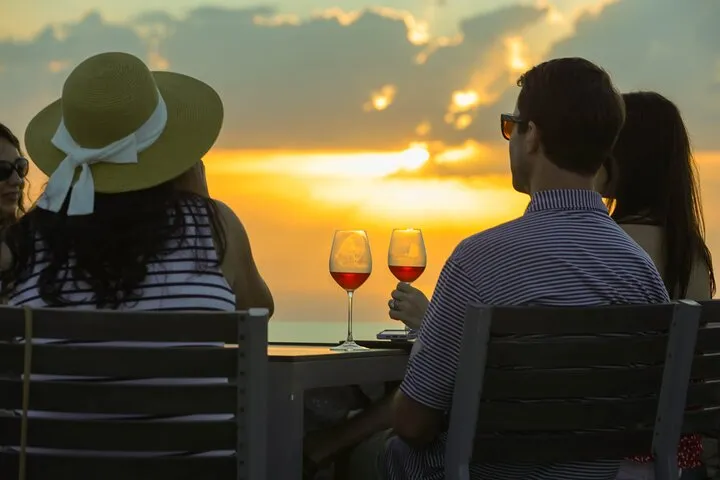 from $197.92
Santorini Wine Stories: Sunset Tour with Tasting & Dinner
A sunset wine tour for up to 8 guests with tastings at the wineries and a dinner to close the evening.
Check Availability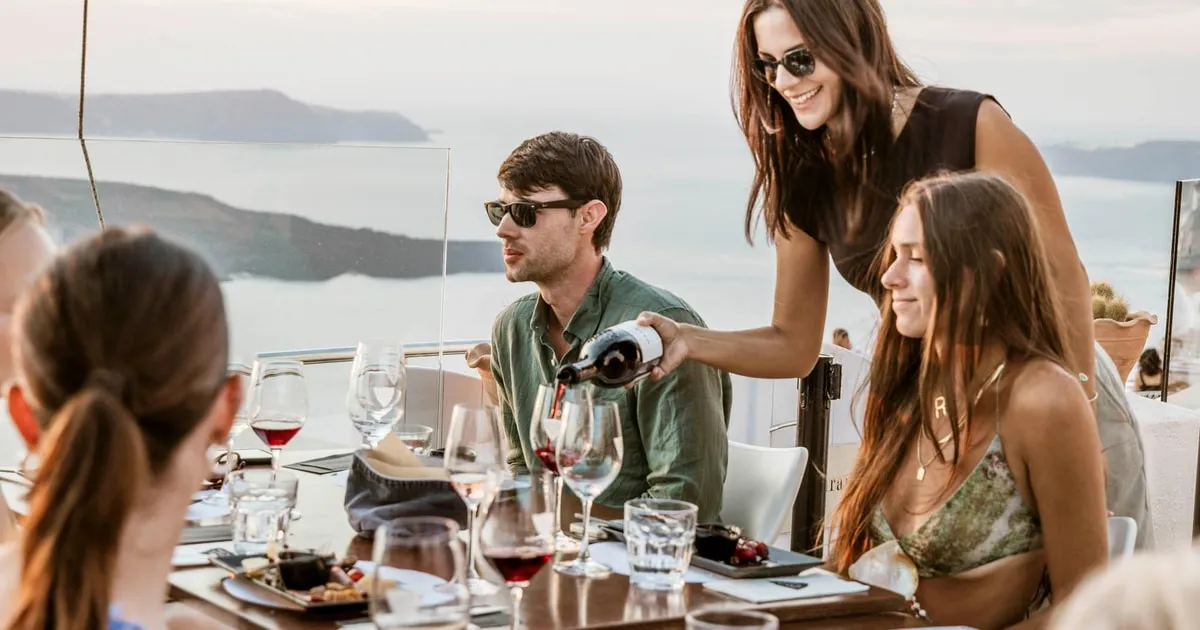 from $190.59
Wine Tasting Tour with Snacks
A four-hour wine tasting tour with snacks and pick-up, private option available.
Check Availability from $171.61
Santorini 3-Winery Tour with 12 Wine Tastings and Oia Sunset
Three wineries and 12 tastings, then the Oia sunset, with pick-up in a Mercedes Vito.
Check Availability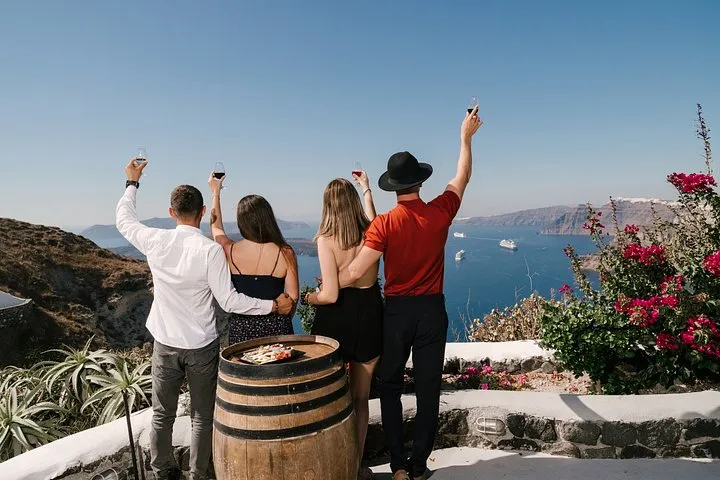 from $143.01
Santorini Wine Tour: Visit 3 Local Wineries with Tastings
The lowest-priced three-winery shared tour: Venetsanos, Roussos and a third winery depending on the morning or afternoon slot, with snacks and a pick-up point.
Check AvailabilityPrices, ratings and details are the platform's own. dollar figures are the listed prices — the platform bills in your account's currency.
What Santo Wines is and where it came from
Santo Wines is not a family estate. It is the sales and tourism arm of the island's agricultural cooperative, and that single fact explains its size, its prices and its view.
The cooperative behind the name
Santo Wines is the winery and wine-tourism centre of the union of Santorini's agricultural cooperatives. The cooperative structure exists because Santorini viticulture is small-scale by nature. Vines grow in low baskets called kouloura, trained close to the ground to shelter from the wind, and the volcanic soil is poor in everything except minerals. No single family farms enough land to run a large operation, so growers pool their harvest through the union. The result is the largest branded producer on the island, with a purpose-built visitor centre on the caldera side of Pyrgos.
For you as a visitor this means two things. First, volume. On a busy afternoon the terrace handles far more guests than any village estate could. Second, breadth. Because the union draws fruit from growers across the island, the tasting list covers the full range of Santorini grapes in one sitting, from Assyrtiko whites to the sun-dried sweet wine called Vinsanto.
The grapes you will taste
Santorini's protected designation of origin, PDO Santorini, is built on the Assyrtiko grape, a white variety that keeps its acidity in the heat and picks up a mineral, almost saline edge from the volcanic ground. Athiri and Aidani are the supporting white varieties, and Aidani is a key component of Vinsanto, the island's traditional sweet wine made from grapes dried in the sun before pressing.
The name causes endless confusion. Vinsanto the Santorini wine predates the Italian Vin Santo of Tuscany, and the island has fought for the right to the name. When you taste at Santo Wines you can try the dry whites, the barrel-aged styles and the sweet Vinsanto side by side, which is the fastest way to understand why wine writers make such a fuss about this island. The low kouloura baskets you will see in the vineyards on the drive in are not decorative. They are centuries of adaptation to wind and drought, and they are one reason Santorini's old vines survived the phylloxera louse that wiped out vineyards elsewhere in Europe.
Why the venue exists at all
The Oenotourism Center, as the winery styles it, was built for exactly the traffic you see there: coaches, cruise groups and independent travellers who want a tasting with a view. Its position above Pyrgos gives it one of the widest caldera panoramas of any winery on the island, and the terraces are tiered so that even a full house has a rail-side seat somewhere.
The practical upshot is that Santo Wines works as a first stop for wine on Santorini. You get the grape story, the Vinsanto story and the caldera story in one place, run by the cooperative that represents the growers. Once you have the vocabulary, the small estates you might visit afterwards, or on a three-winery tour, make far more sense.
What a visit is actually like
A visit to Santo Wines breaks into three parts: the tasting, the terrace and the shop. Here is what each delivers and where people waste time.
The tasting and the food
Tastings are seated at tables on the terraces, with flights that run from the dry Assyrtiko whites through to the sweet Vinsanto. The exact flights and prices are published on the winery's booking page rather than as a fixed public tariff, so book through santowines.gr to see what is on offer for your date. Food is a proper part of the offer here, not an afterthought. There is a restaurant serving Greek dishes built around local produce, and the island's food traditions, from fava to tomato fritters, pair naturally with the whites. Our pick is to time your visit so the tasting and a late lunch merge into one long sitting.
One practical warning. On a crowded afternoon service slows to a pace that surprises visitors in a hurry. If you are fitting Santo Wines between other stops, give it a generous slot or come at a quiet hour rather than compressing it into forty minutes.
The terrace and the view
The terraces are the reason half the island ends up here. You look south-west along the caldera rim, with the volcanic islands of Nea and Palea Kameni visible in the flooded caldera below and Thirassia on the far rim. The Santorini caldera is a collapse basin formed by the enormous Minoan eruption around 1600 BC, and drinking wine above it is a geology lesson you can taste.
At sunset the terrace fills. The winery sits on the western rim, so the sun goes down over the caldera and the light on the cliffs is the same show people crowd into Oia to see, just with a glass in your hand and a table under you. If the sunset is the point of your visit, either book well ahead or join one of the sunset wine tours that end here. Note that the caldera view here is the wide, geological kind, not the whitewashed-village kind. For blue domes and cliff-hung lanes you want Oia or Imerovigli afterwards.
The shop and buying bottles
The shop at the exit sells the cooperative's full range, including bottle styles that never reach export markets. Prices on the island are generally no worse than what the same bottles cost abroad once shipping is added, and the shop will box purchases for travel. Checked luggage is the constraint: wine bottles are heavy, and if you are flying onwards the day after your visit, think about weight allowances before you buy a case.
Vinsanto deserves a specific word. It is the wine most people come planning to buy, and the sun-dried sweet style travels well and keeps for years. If you only take one bottle home from Santorini, our pick is a Vinsanto from the cooperative rather than a dry white, simply because nothing else tastes quite like it. For more on what to carry home, see our page on Santorini shopping.
Opening hours and the quiet times
Santo Wines is open all year, which makes it one of the few wine experiences on the island you can plan around in any season. The fine detail of daily hours is published by the winery rather than fixed in a public tariff.
Hours and booking
The winery describes itself as open all year, and bookings run through santowines.gr. The exact daily opening and closing times, along with tasting prices, are listed on the winery's own booking page, so check there rather than relying on a blog screenshot. Because the venue also operates as a restaurant, capacity is managed in seatings, and the terrace tables with the best caldera line are the first to go.
In practice, book at least a day ahead for anything between late spring and early autumn (our estimate). In winter you can often walk in, and the terrace on a clear February afternoon, with the sea at around 17 degrees Celsius and the crowds gone, is one of the island's underrated experiences. See our notes on the best time to visit Santorini for how the seasons differ.
When it is quiet
Two waves of crowd arrive each day (our estimate). The first is the late-morning tour circuit, when coaches and minibuses on the village route stop in. The second is the sunset wave, which builds from late afternoon as the day-trippers position themselves for the view. Between those waves, roughly mid-afternoon on a weekday, the terraces empty out and service snaps back to normal speed.
If you care about the photo rather than the sunset, mid-afternoon also gives you the best light for the caldera itself, with the cliffs lit and the crater islands sharply defined. If the sunset is the point, accept the crowd, book ahead and arrive early enough to claim your table before the rush. For month-by-month crowd and weather detail, our Santorini weather page has the numbers.
Visiting with a group or in winter
The size of the venue is an advantage for groups. Unlike the village estates, which cap visitors at a handful of tables, Santo Wines can absorb a coach party without anyone standing. This makes it the default stop on Santorini wine tours, and it is why several of the tours listed on this page either stop here or finish here.
In winter the dynamic reverses. The cooperative keeps the centre open all year while many independent wineries cut hours or close, so Santo Wines becomes the reliable option in the quiet months. The trade-off is atmosphere: a huge terrace on a windy January day is a different experience from the same terrace in June. Bring a layer, because the rim catches the wind even when the caldera below is calm. More broadly, our Santorini travel tips cover what changes off season across the island.
Getting to Santo Wines
The winery sits on the caldera side of Pyrgos, in the island's interior south-west. There is no village you walk through to reach it, so your choices are bus plus a walk, a rented vehicle or a tour with pick-up.
By bus from Fira
From Fira, the KTEL bus towards Pyrgos costs $2.46 (€2.20) and drops you in Pyrgos village. The winery sits on the caldera side of the village, a walk of fifteen to twenty minutes downhill from the village square (our estimate). Departure times are seasonal and published only in the KTEL timetable PDF, so check that on the day rather than trusting this page. The return leg is uphill, which matters in July heat, so our pick for the return is to walk back to the square, or better, to plan the visit for late afternoon when the sun is lower.
Buses radiate from the Fira bus station, which also connects you to Kamari, Perissa beach and Oia. If Pyrgos buses are infrequent on your date, the Megalochori or Emporio routes pass within taxi distance of the winery. See our page on getting around Santorini for how the network works.
By car, ATV or taxi
A rented car or quad solves the problem completely. The winery has parking on site, and the drive from Fira takes around fifteen minutes by the interior road (our estimate). From Megalochori it is only a few minutes further south. If you rent an ATV, remember that Greek law requires a licence valid for the engine size, above 50 cc a motorcycle category, and that renting on a car licence can leave you uninsured. Our ATV rental guide explains the rules.
Taxis exist but no official Santorini tariff is published, so agree or check the fare in the app before you set off. A one-way ride from Fira is the sensible middle option if you want the freedom of leaving on your own schedule without renting for the day. The winery's address for any navigation app is Pyrgos, on the caldera side, and the pin on the map below is accurate.
On a tour, our pick for most visitors
Tasting rooms and driving do not mix, and the flights at Santo Wines are worth doing properly. A guided tour removes the whole question of transport, adds the other wineries, and in most cases costs less than a car plus taxis plus separate tastings once you count what is included. The sunset option that ends on the Santo terrace is the version we would choose: the small-group sunset wine tour with Santo Winery finishes the day exactly where you want to be standing at golden hour.
If your priority is the Oia sunset rather than the caldera one, the three-winery tour that ends with the Oia sunset is the alternative. And if you want to combine wine with the island's archaeology, the full-day bus tours from Fira that pair Akrotiri with a winery stop are covered on our Santorini tours page.
How much time to give it, three ways
Santo Wines rewards more time than most visitors give it, but the venue also absorbs time happily if you let it. These are the three routings we would actually plan.
The three routings compared
The routing you choose depends on what else is on your day. The quick stop pairs the winery with Pyrgos village. The afternoon plan treats it as the main event.
The full evening builds the whole night around the terrace. Note that walk and drive times here are our estimates, not official figures.
| Routing | Time to allow | How it works | Best for |
|---|---|---|---|
| Quick tasting stop | About 1.5 hours | Bus to Pyrgos, walk down to the winery (our estimate 15-20 min), one tasting flight, walk back uphill to the square and see the village | Travellers fitting wine into a village day, on a budget |
| Winery afternoon | 3 to 4 hours | Arrive mid-afternoon before the sunset wave, long seated tasting, late lunch or meze at the restaurant, terrace time as the light turns | Anyone who wants the wine to be the day's main event, without a car |
| Sunset evening | 4.5 to 5 hours | Guided tour with pick-up that ends on the Santo terrace, dinner at the restaurant or on the tour, taxi or drop-off back to your hotel | Couples and anyone who wants the caldera sunset with a glass in hand |
What we would do with one afternoon
Our pick is the winery afternoon, and here is the logic. The quick stop gets you the wine but misses the thing that makes this venue different, which is sitting above the caldera long enough for the light to change. The full evening is wonderful but you will pay for it twice: in the tour price and in the crowd on the terrace at sunset.
The afternoon version lands in the quiet window we described above, lets you order food at the restaurant, and still ends with the sunset if you linger. It also leaves the Oia sunset free for another day, because cramming both sunsets into one evening is the classic Santorini mistake. If you are building a whole day around the south of the island, our three-day itinerary slots this afternoon in sensibly.
Santo Wines in context: a short timeline
The winery is modern, but the wine and the landscape it sits above are ancient. These are the dated steps that explain both.
-
c. 1600 BC
The Minoan eruption reshapes the island
The massive Theran eruption destroys the Bronze Age town at Akrotiri and collapses the volcano into the flooded caldera whose rim Santo Wines now occupies.
-
Antiquity onwards
Viticulture takes root in volcanic soil
Grape growing establishes itself on the volcanic ground, where the poor soil and lack of phylloxera allow ungrafted vines to survive.
-
Over the centuries
The kouloura basket training develops
Growers train vines into low woven baskets close to the ground to protect them from wind and to capture scarce moisture, the distinctive shape visible across the island.
-
The 20th century
Growers organise into a cooperative
Santorini's small growers form a union of agricultural cooperatives to jointly press, make and market their wine, which becomes the Santo Wines brand.
-
Modern era
PDO Santorini protects the name
The island's wines win protected designation of origin status, with Assyrtiko as the lead white variety and Vinsanto as the traditional sun-dried sweet wine.
-
Recent decades
The Oenotourism Center opens at Pyrgos
The cooperative builds its wine-tourism centre on the caldera rim above Pyrgos, giving the public direct access to tastings and the union's full range.
Sources: facts pack entries on the Minoan eruption, PDO Santorini viticulture and Santo Wines as the cooperative union's winery and wine-tourism centre.
Dos and don'ts at Santo Wines
Do
- Book through santowines.gr ahead of time in season, especially for terrace tables and sunset seatings
- Drink water between flights and eat. The restaurant and meze plates exist for a reason
- Try a Vinsanto even if sweet wine is not usually your thing. It is the island's signature style and hard to find at this quality elsewhere
- Time your visit for mid-afternoon on a weekday if you hate crowds (our estimate for the quiet window)
- Check the KTEL timetable PDF before relying on the bus, since departures are seasonal and change with the calendar
- Bring a layer, because the caldera rim catches the wind even on warm days
Don't
- Do not drive yourself if you plan to work through a full flight of tastings. Take a tour or a taxi
- Do not arrive at sunset unbooked and expect a rail-side table. That is the one slot everyone wants
- Do not confuse Vinsanto with the Italian Vin Santo. The Santorini style is older and legally its own thing
- Do not plan the visit into a forty-minute slot between other stops. Service slows when the terrace is full
- Do not expect whitewashed lanes and blue domes here. This is a wide geological view, and for village scenery you want Oia or Pyrgos itself
- Do not overload your suitcase with bottles the day before a flight. Weight allowances bite
Five things most visitors do not know
Small facts that change how you plan the visit and how you read the wine list.
The list
Most people arrive, taste, photograph the caldera and leave. These five points are the difference between that and actually understanding the place.
- Santo Wines is a cooperative, not a family estate. It is the wine-tourism centre of the union of Santorini's agricultural cooperatives, which is why it is the largest branded producer on the island and can absorb coach groups that would swamp a village winery. facts pack, wine section
- The vines grow in baskets, not rows. The kouloura system trains vines into low woven baskets close to the ground, sheltering the fruit from the wind and capturing moisture, an adaptation centuries old and one reason the island's old vines survived phylloxera. facts pack, wine section
- The sweet wine has a protected name with a long pedigree. Vinsanto is the traditional sun-dried sweet wine of Santorini, made largely from Aidani grapes dried in the sun before pressing, and it is the bottle most locals would send you home with. facts pack, wine section
- The view is the erupted volcano itself. The caldera below the terrace is the flooded collapse basin of the Minoan eruption around 1600 BC, one of the largest volcanic events in human history, and the dark islands you see are lava domes from eruptions as recent as 1950. facts pack, geography and volcano sections
- It is one of the few wineries open all year. The cooperative's centre keeps going through winter while many independent estates cut hours, which makes it the dependable tasting option in the quiet months. facts pack, wine section
Map: Santo Wines and what is nearby
Santo Wines sits on the caldera side of Pyrgos in the island's interior. The pins below show it and the places worth combining with it.
- 1 Santo WinesThe cooperative's winery and Oenotourism Center on the caldera rim, open all year.
- 2 PyrgosThe hilltop village above the winery, worth an hour for its lanes and views before or after your tasting.
- 3 MegalochoriA quiet wine village a short drive south, home to estates that pair well with Santo Wines on a wine day.
- 4 Akrotiri lighthouseThe island's southwestern point, a favourite sunset spot if you skip the winery crowd.
- 5 Akrotiri archaeological siteThe Bronze Age town buried by the eruption whose caldera you are drinking above, an easy pairing in one afternoon.
- 6 VlychadaThe sculpted cliffs and marina at the island's southern end, a swim stop after your tasting if you have a car.
Numbers match the pins on the map.
Nearby: what to combine with Santo Wines
The winery sits in the island's interior, which puts three very different stops within easy reach.
Pyrgos village
The hilltop village that Santo Wines sits below, with labyrinthine lanes, roof terraces and the whole island laid out from its castle ruin. It is the natural bookend to a winery visit, and our Pyrgos guide covers the walk.
15-20 min on foot downhill or back up (our estimate) Read the guideAkrotiri archaeological site
The Bronze Age town buried by the same eruption that carved the caldera below your wine glass. Pairing the two in one afternoon, ruins first and wine after, is the most coherent half day on the island. Tickets and hours are on our Akrotiri tickets page.
About 15 min by car (our estimate) Read the guideMegalochori
A wine village of bell-topped lanes and small family estates a few minutes south. If Santo Wines gave you the big picture, Megalochori is where you meet the small producers, and many wine tours do both in an afternoon.
About 10 min by car (our estimate) Read the guidePractical questions about Santo Wines
How do I get to Santo Wines from Fira?
Take the KTEL bus from Fira towards Pyrgos for $2.46 (€2.20) and walk downhill to the winery, about fifteen to twenty minutes (our estimate). Departure times are seasonal, so check the KTEL timetable PDF. Otherwise drive, take a taxi, or join a guided wine tour with pick-up. Our pick is the tour, since it removes the driving-after-tasting problem entirely.
How much does a wine tasting cost in Santorini?
At Santo Wines, tasting prices are listed on the winery's own booking page rather than published as a fixed tariff. What we can quote is guided tours: three-winery tours with twelve tastings run from $143.01 as listed, and the small-group sunset tour ending at Santo Wines is $201.80. For context on island costs generally, see our Santorini costs page.
Why is Vinsanto so expensive?
Vinsanto is made from grapes dried in the sun before pressing, which concentrates them and means a bottle holds the juice of far more fruit than a dry wine. Yields on the island are low by nature, the volcanic soil is poor and the vines are hand-worked in baskets against the wind. All of this is true of every Santorini wine, but the drying adds another stage of labour and loss to the sweet style.
Is Santo Wines open all year?
Yes. The winery describes itself as open all year, which makes it one of the few wine venues on the island you can rely on in winter. Exact daily hours and tasting prices are published on santowines.gr. In the quiet months you can often walk in without a booking, while between late spring and early autumn you should reserve ahead.
Can I visit Santo Wines without a tour?
Yes. Independent visitors book tastings directly through the winery's site and take a seat on the terrace. The practical questions are transport and timing. There is no bus stop at the door, the walk from Pyrgos square is uphill on the way back, and the terrace is busiest at sunset. If you have a car or a taxi budget, going independently gives you full control over when you arrive.
What is the best time of day to visit Santo Wines?
Mid-afternoon on a weekday is the quiet window, between the late-morning tour wave and the sunset rush (our estimate). The light on the caldera is also better for photos then. If the sunset itself is the goal, book a table or a tour well ahead, because that is the most contested slot on the terrace. For seasonal crowd levels, see our best time to visit page.
Is Santo Wines worth it compared to smaller wineries?
It serves a different purpose. Santo Wines is the big-picture stop: the cooperative's full range, a proper restaurant and the widest caldera terrace on the island. The village estates offer intimacy and a single producer's story. Our pick for a first visit is Santo Wines to learn the grapes, then a smaller estate on another day if wine has hooked you.
Where Santo Wines fits in a day
Three honest placements, depending on how much of the island you are trying to see and how much you like wine.
Wine-first afternoon, ruins before it
The most coherent half day on the island puts cause and effect in order. Spend the morning at the Akrotiri archaeological site, where the town buried by the eruption around 1600 BC gives you the catastrophe that made the caldera. Then drive or taxi north-east to Santo Wines for a mid-afternoon tasting, with Akrotiri's entry at $22.40 (€20) for adults. You will be at the winery in the quiet window, and the view below your table will mean something by the time you sit down.
Add Pyrgos village before or after the wine, since you are practically next door. Eat at the winery restaurant or walk back up into Pyrgos for dinner. This routing works with a rental car, with two taxis, or on a guided tour that combines Akrotiri with a winery stop. Our Akrotiri guide has the site detail and our one-day itinerary shows how to stretch it across a full day.
Wine tour evening, no driving at all
If this is your holiday and not a logistics exercise, book the evening tour and let someone else drive. The small-group sunset tour with Santo Winery runs four to four and a half hours and ends on the terrace for the caldera sunset. The wine adventure with twelve tastings and tapas is the higher-volume alternative with three wineries and hotel pick-up. Both mean you can drink every wine on the list without a thought about the road home.
Build the day lightly around it. Beach morning at Perissa or Vlychada, back to your hotel for a rest, pick-up in the late afternoon, and the tour carries you through to dark. That is a genuinely good day on Santorini, and it does not require you to see the blue domes at all, though they are covered in our blue domes guide if you must.
The short visit, if wine is a side dish
Maybe you are here for the beaches and the villages and wine is a nice-to-have. Then give Santo Wines ninety minutes on the way past, not an afternoon. Come by car or taxi in the mid-afternoon lull, take one flight of the dry whites plus a Vinsanto to finish, buy your bottle in the shop and move on to Pyrgos village or the Akrotiri lighthouse for sunset instead, where the crowd is thinner and the view costs nothing.
Skip the restaurant on this routing and eat in the villages. The winery will still be there another year, and the wide caldera terrace is best appreciated when you are not watching the clock. If your whole trip is compressed into a day or two, our two-day itinerary and Santorini map will help you decide what earns the slot.
Santo Wines On Video
Three videos that show the place before you go.
SantoWines Winery: The Largest Winery in Santorini
SantoWines Winery: The Largest Winery in Santorini, from Greece Secrets | Travel Planning, Tips and Places.
Video: Greece Secrets | Travel Planning, Tips and PlacesSanto Wines in Santorini Greece, Showcasing Assyrtiko, Vinsanto & More
Santo Wines in Santorini Greece, Showcasing Assyrtiko, Vinsanto & More, from Santorini Dave.
Video: Santorini DaveSantorini’s BEST WINES and WINERIES [Complete Guide]
Santorini’s BEST WINES and WINERIES [Complete Guide], from Greece Explained.
Video: Greece ExplainedVideos load from YouTube only when you press play.
Prices, hours and terms are set by the venue or operator and confirmed at checkout.
We may earn a commission if you book through one of our links, at no extra cost to you. Full affiliate disclosure