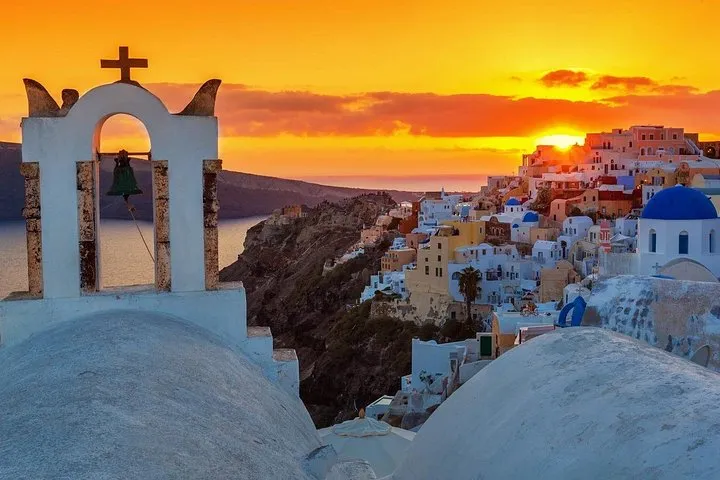
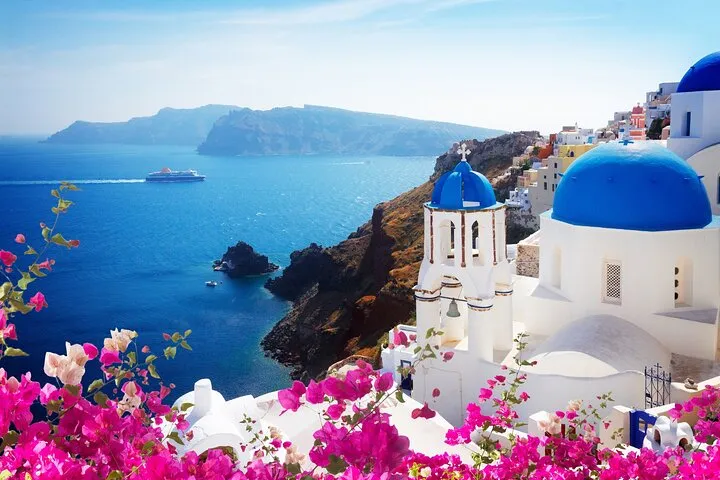
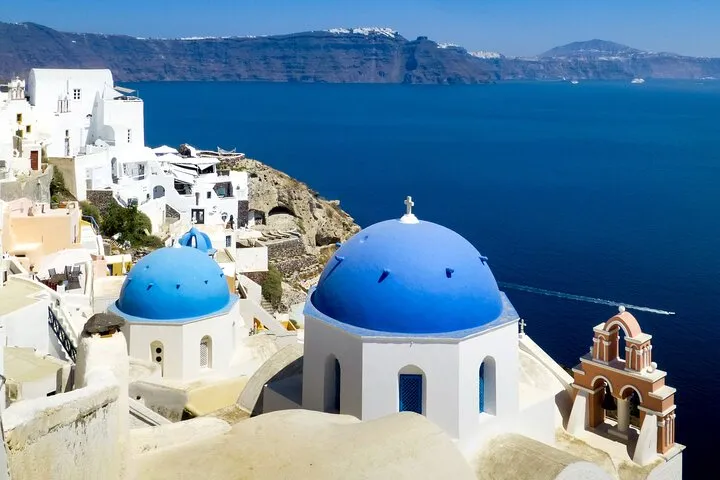
Oia at sunset from the castle walls, blue domes and windmills above the caldera, Santorini Greece
Santorini, Greece: An Independent Island Guide
Santorini, Greece is a drowned volcano: a crescent of cliffs with white villages on the rim and two black islets in the middle of the bay. This guide sets out the official prices, the closing days and the boat, bus and village choices, so you can plan the island without guesswork.
Santorini, Greece is a crescent of volcanic cliffs in the Cyclades, famous for the caldera views of Oia and Fira and a Bronze Age eruption that buried the town of Akrotiri. The buses are cheap, the cable car is not, and the island rewards three days more than one.
Key takeaways
Base yourself on the caldera rim for the view or on the black-beach side for the price, then compare the areas and their hotels in where to stay in Santorini.
Oia sits at the northern tip of the caldera rim, a village of cave houses and the island's most photographed churches. Its castle, the Castle of Agios Nikolaos, is the classic sunset viewpoint and costs nothing to enter. The village has 1,087 residents (2021 census) and one main street, Nikolaou Nomikou. The practical problem is the crowd, which gathers an hour before the sun drops. Come for morning light instead, or walk down the steps to Ammoudi Bay for a swim while everyone else stands at the rail. Photo: Eduard Marmet, CC BY-SA 2.0, via Wikimedia Commons.
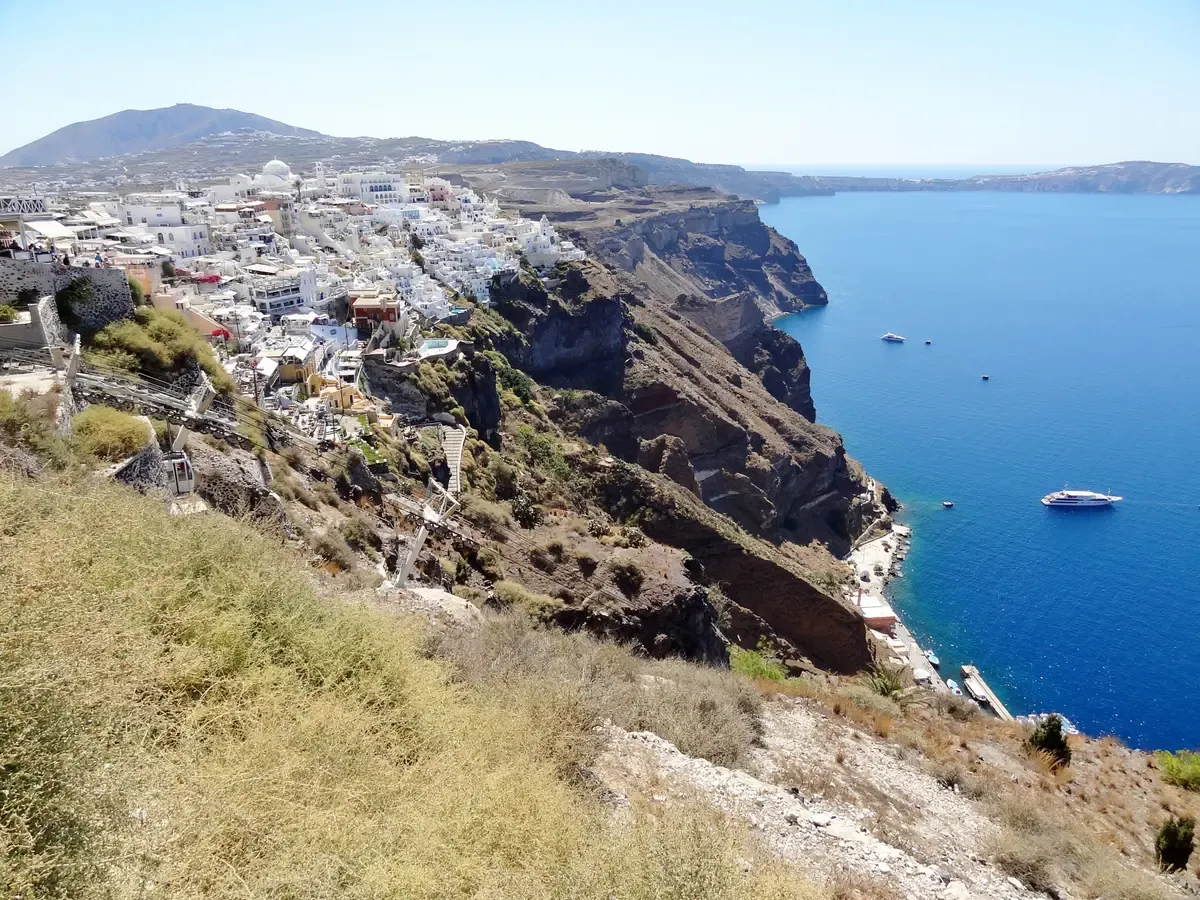
Fira is the capital and the working hub of the island, perched on the caldera rim at about 220 m. The name is a variant pronunciation of Thira. Buses to every corner start at its bus station, so most itineraries pass through daily. It also holds two museums: the Museum of Prehistoric Thera keeps the Akrotiri wall paintings found on the island, and the Archaeological Museum of Thera covers the older digs. Streets are steep and busy on cruise days, so plan museum time for the mornings. Photo: Olaf Tausch, CC BY 3.0, via Wikimedia Commons.
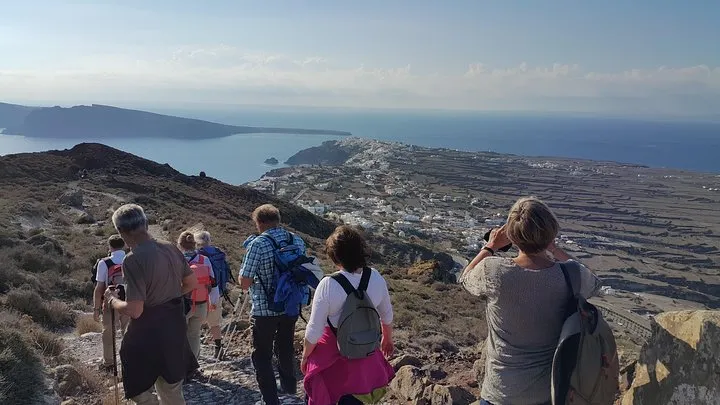
The rim path from Fira through Firostefani to Imerovigli and on to Oia is the best free thing on the island. Our estimate puts it at about 10 km and 3 to 5 hours of walking, with no official length published. Imerovigli is the quiet middle, built highest on the rim, and its Skaros Rock carries the ruins of the medieval castle-town that once defended the island. Walk it in the morning before the heat, take water, and catch a bus back from Oia for a couple of euros. Photo: Moonik, CC BY-SA 3.0, via Wikimedia Commons.
Akrotiri is a Bronze Age town buried in ash by the Theran eruption around 1600 BC and dug since 1967, first by Spyridon Marinatos and now by Christos Doumas. Multi-storey houses, sewers and wall paintings survive under the modern roof. No unburied human remains were found, only a single gold goat, so the town was evacuated in time. Entry is $22.40 (€20), reduced $11.19 (€10). Mondays and Thursdays it closes at 15:30, and hours step down through autumn. Combine it with the Red Beach viewpoint above. Photo: Norbert Nagel, CC BY-SA 3.0, via Wikimedia Commons.
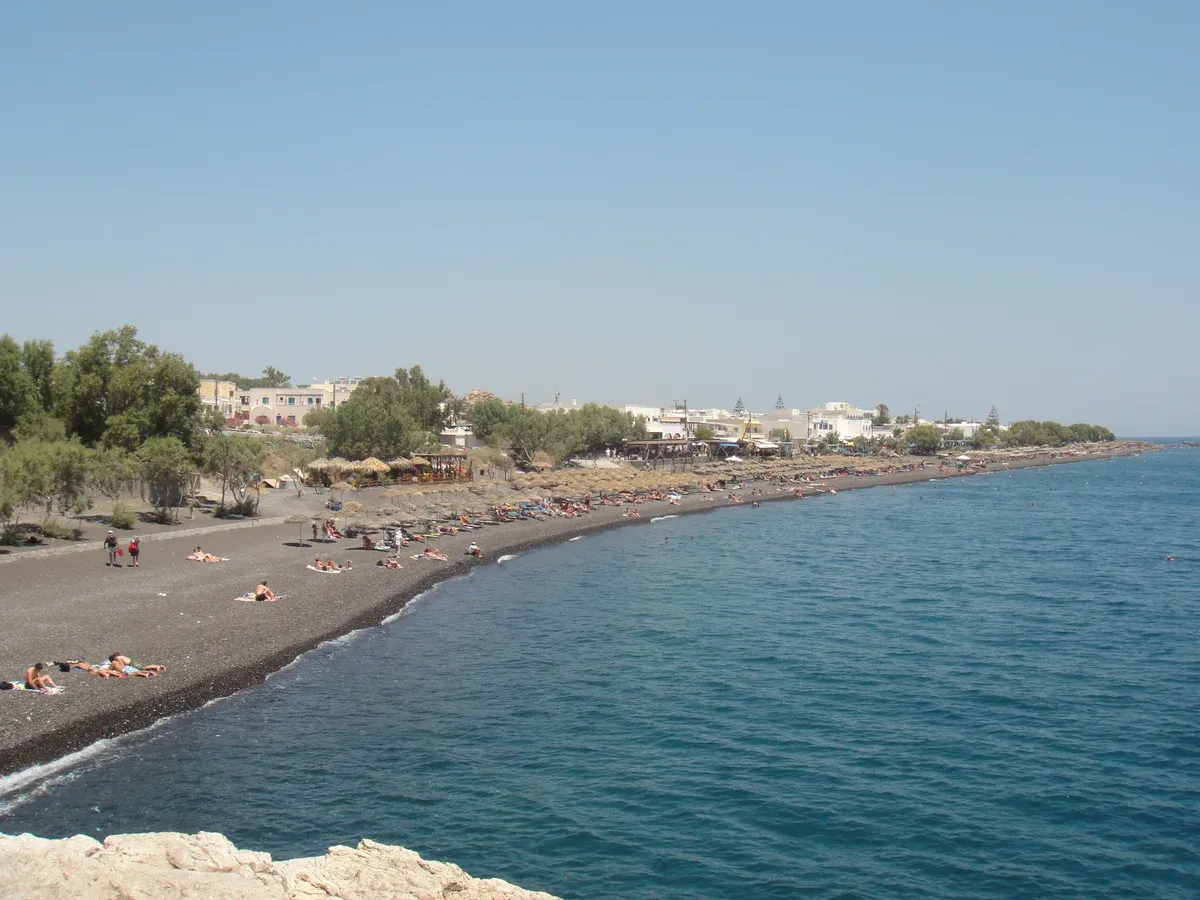
Kamari and Perissa face each other across Mesa Vouno, the headland that hides Ancient Thera. Both are long dark-sand beaches, with Perissa running on into Perivolos. This is the affordable side of the island for accommodation and eating, a bus ride from Fira for $3.02 (€2.70). Above Kamari sits Ancient Thera, a Dorian city from the 9th century BC reached by a winding road, entry $11.19 (€10), closed Wednesdays. Come here on the day you want swimming first and ruins after. Photo: Kamarisantorini, CC BY-SA 3.0, via Wikimedia Commons.
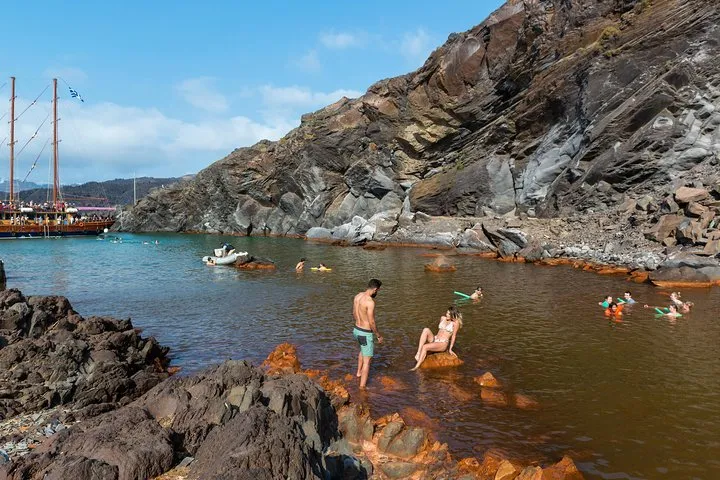
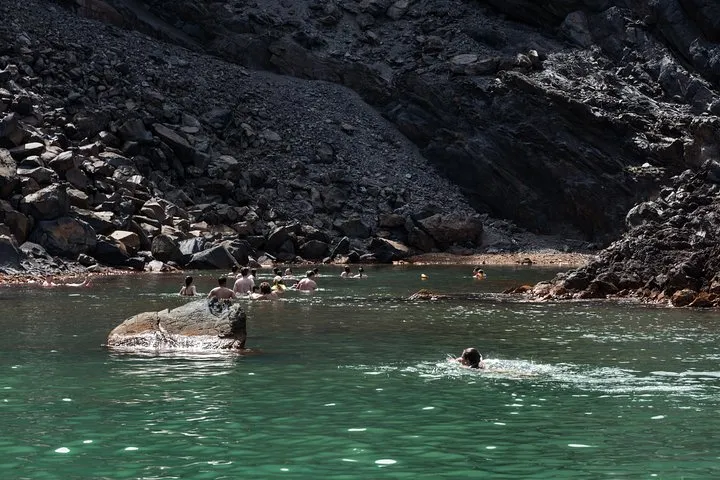
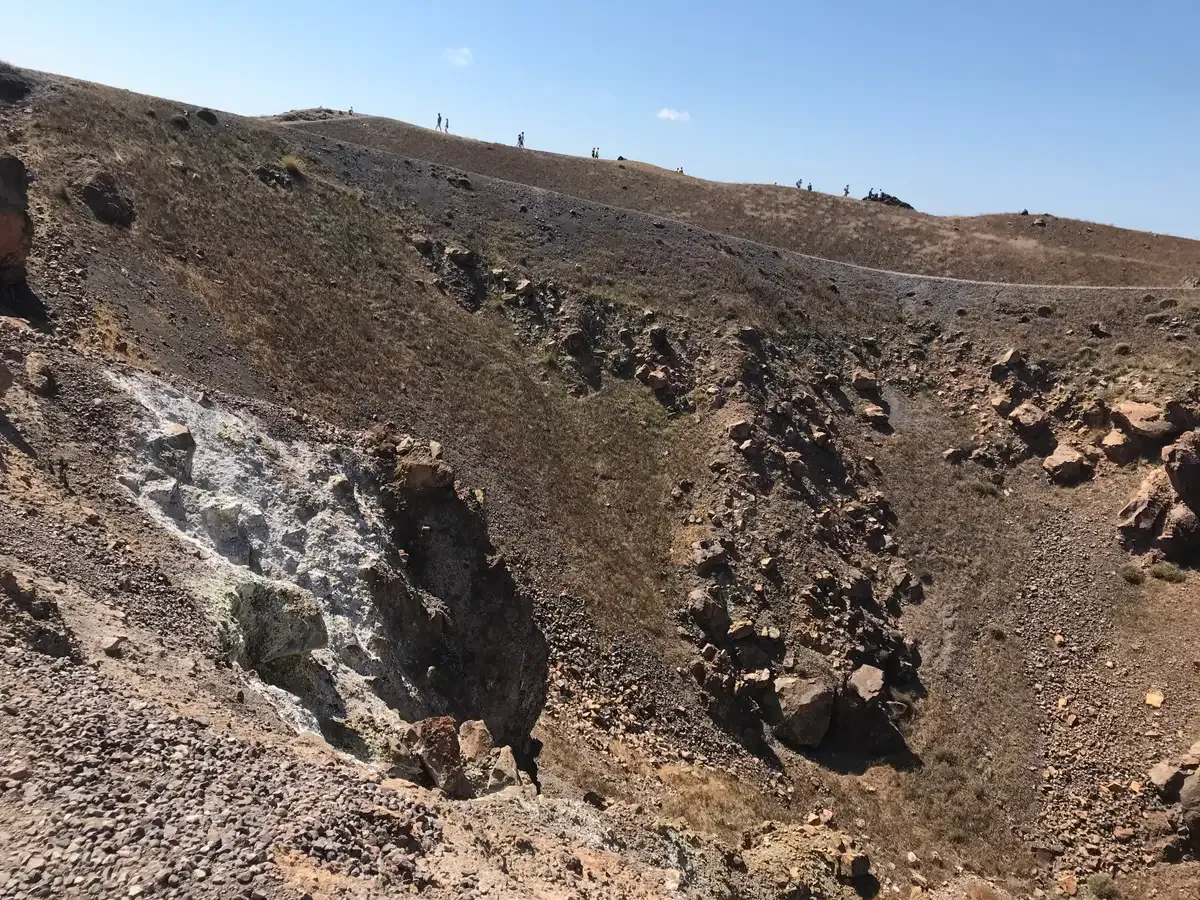
Nea Kameni and Palea Kameni are young volcanic islets in the middle of the caldera, built by eruptions over two millennia, the last a small lava dome in 1950. You reach them only by boat, mostly from Fira's Old Port. Walk the crater trail for about 1.5 hours on the standard trip, then swim at the warm iron-rich springs off Palea Kameni, where boats moor offshore. The volcano park charges a €5 fee paid on the island, on top of most boat tickets. Boats also cross to inhabited Thirassia on the caldera's far rim. Photo: Zde, CC BY-SA 4.0, via Wikimedia Commons.
Twenty-three places from Oia in the north to Vlychada in the south. Red pins charge an official entry or park fee, blue pins are beaches, boats and viewpoints, dark pins are the villages people base in, grey pins are the ways in and out. The full Santorini map adds every page on the site.
Entry or park fee
Beach, boat or viewpoint
Village to base in
Airport, port, cable car
1OiaNorthern tip of the rim, the sunset village. Bus from Fira $2.46 (€2.20).
2Ammoudi BayOia's harbour below the cliff, boats to Thirassia and the volcano.
3ThirassiaThe inhabited island on the far rim, reached by boat.
4ImerovigliThe highest village on the rim, on the Fira-Oia path.
5Skaros RockRock with the ruins of the medieval castle-town. No ticket.
6FirostefaniQuiet rim village a short walk north of Fira.
7FiraThe capital and bus hub, at about 220 m on the rim.
17Santo WinesWinery of the island's cooperatives, caldera terrace, open all year.
18PyrgosInland hilltop village with the whole island below it.
19MegalochoriWine-country village between Fira and Akrotiri.
20AkrotiriBronze Age town under a roof. $22.40 (€20).
21Red BeachLand path closed for rockfall. View it from above or by boat.
22Akrotiri lighthouseThe south-west cape, a sunset spot without the Oia crowd.
23VlychadaMarina and wind-cut pumice cliffs. Most catamarans leave from here.
Numbers match the pins on the map.
The Must-See List, North To South
Eight places explain the island. Run them top to bottom and you will have seen Santorini, not just photographed it.
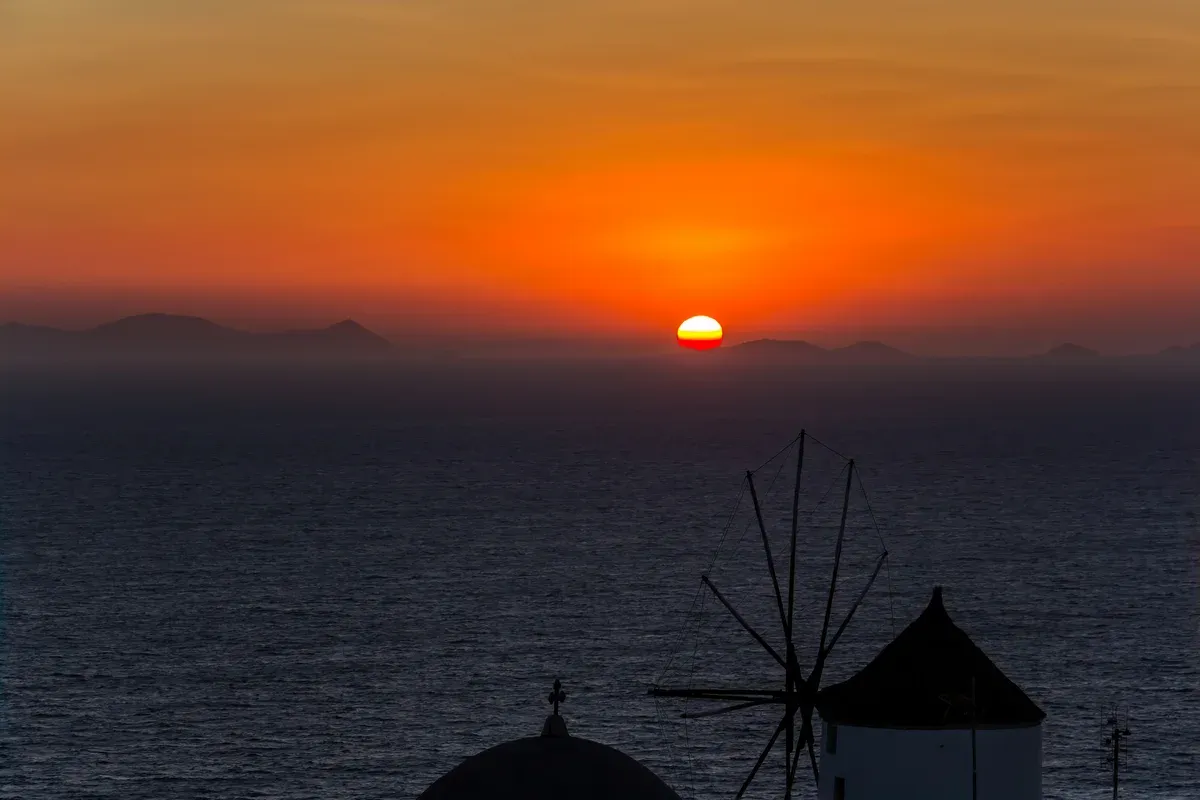
Sunset over the Aegean from Oia. Photo: Edgardo W. Olivera, CC BY 2.0, via Wikimedia Commons
Oia castle sunset
The Castle of Agios Nikolaos, the old castle of the Epano Meria district, is the monument everyone photographs at dusk. It is free, it is on the Ephorate's monument list, and the crowd arrives long before the light goes. Arrive early or pick a different evening for Santorini sunset.
The walk from the bus stop runs down the main street of Oia, Nikolaou Nomikou, past the blue domes of the village churches. If you want the same view without the crush, the terraces of Imerovigli give it a day earlier or later.
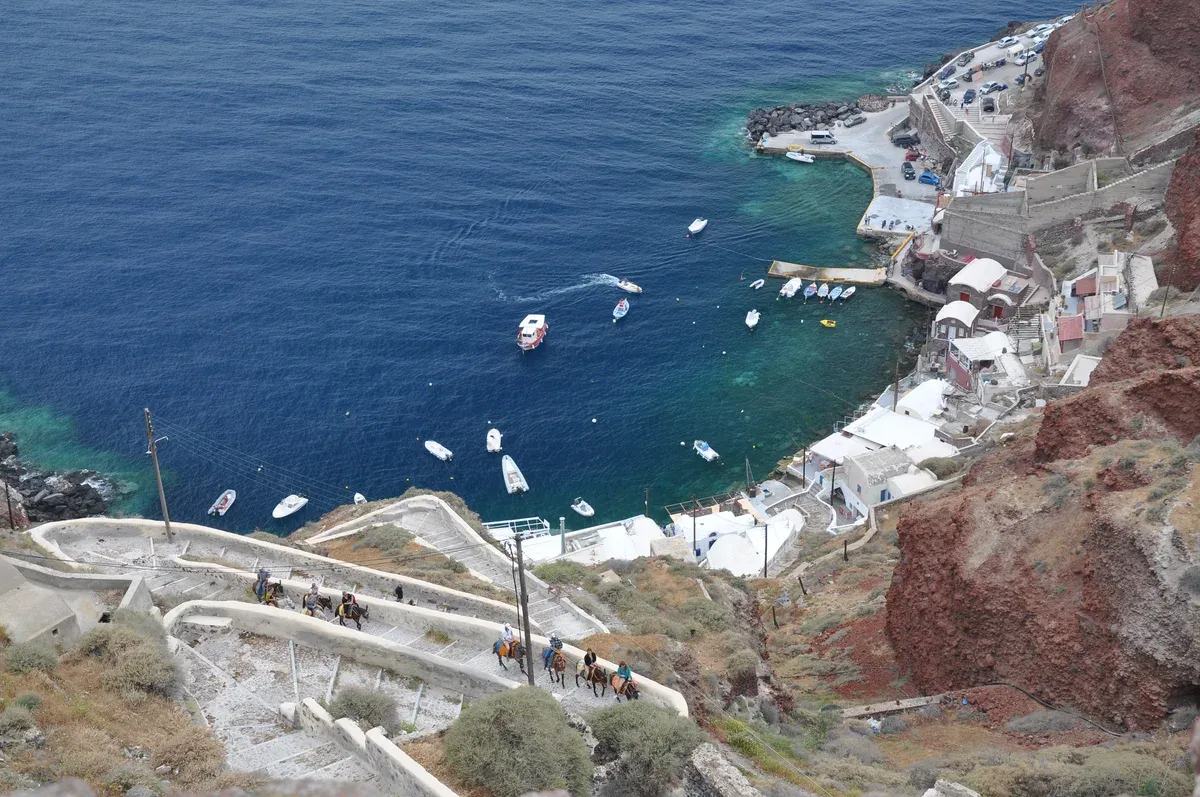
Ammoudi harbour below Oia. Photo: Moonik, CC BY-SA 3.0, via Wikimedia Commons
Ammoudi Bay
Ammoudi is Oia's small red-cliff harbour below the caldera wall, reached from the village by a long stairway or by the switchback road. Fishing boats still work out of it, and tavernas line the water's edge. Boat trips to Thirassia and the volcano leave from here as well as from Fira.
The step count is not officially stated, so call it several hundred and decide before you descend if you will walk back up in the heat of the afternoon. See Ammoudi Bay for the practical detail.
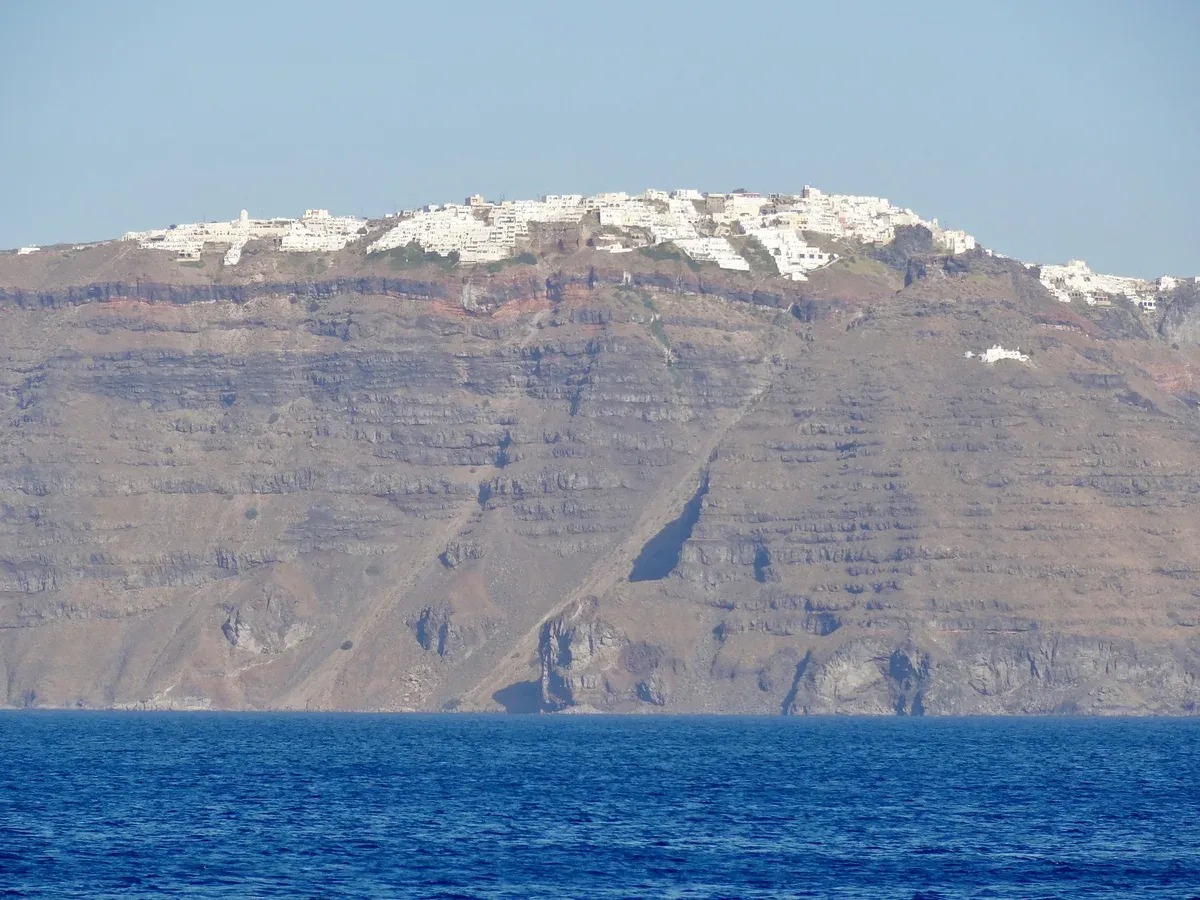
The caldera cliff below Imerovigli. Photo: Olaf Tausch, CC BY 3.0, via Wikimedia Commons
The Fira-Oia caldera path with Skaros Rock
The rim walk between Fira and Oia is our estimate at about 10 km and 3 to 5 hours, the best free half-day on the island. It passes through Firostefani and Imerovigli, where a signed spur climbs Skaros Rock, the rock that carried the medieval castle-city of Skaros. There is no ticket for the rock.
Start early, carry water, and finish in Oia for a bus back. If three hours on foot sounds long, the caldera hike with a guide covers the same ground with water and snacks.
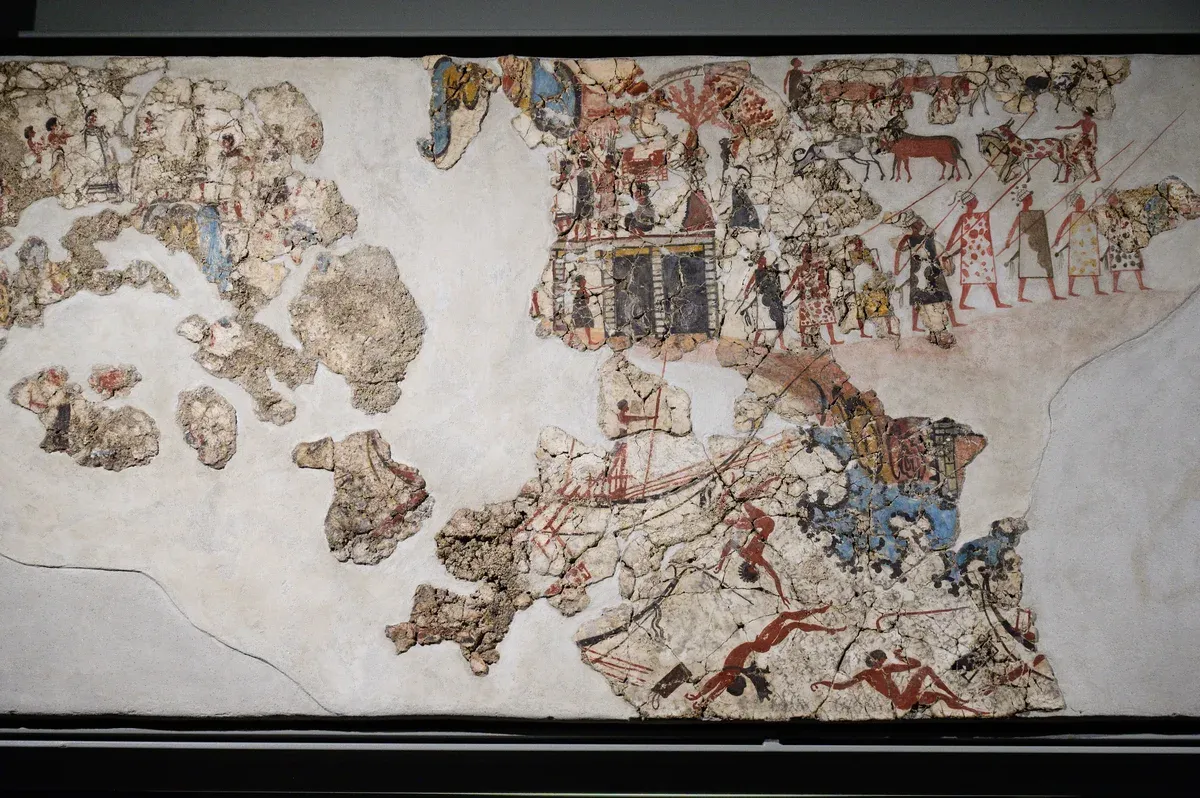
The Assembly on the Hill fresco from Akrotiri, Museum of Prehistoric Thera. Photo: Zde, CC BY-SA 4.0, via Wikimedia Commons
Fira and the Museum of Prehistoric Thera
Fira, the capital on the rim at about 220 m, is where the buses meet and where the island's best museum stands. The Museum of Prehistoric Thera holds the wall paintings and finds from Akrotiri, the fresco fragments that give the buried town its colour. Entry is $11.19 (€10), hours 08:30 to 15:30, closed Tuesdays.
The Archaeological Museum of Thera, also $11.19 (€10), covers the earlier digs and stays open late on Saturdays. Plan both for a morning, since neither opens after dark.
Fira along the caldera rim. Photo: Olaf Tausch, CC BY 3.0, via Wikimedia Commons
The cable car and Old Port
Below Fira, the Old Port at Gialos is where cruise tenders land and where the volcano boats leave. Up the cliff runs the Fira cable car, built by Doppelmayr and opened in 1982, a ride of about 3 minutes up to Fira at about 220 m. It runs every 20 minutes, from 07:00 to 23:00 in June, July and August.
A one-way ticket is $11.19 (€10), a child or a piece of luggage $5.59 (€5), and a share of each ticket goes to the mule drivers who work the Karavolades stairs beside it. That stair path is several hundred steps, and cruise days queue both options.
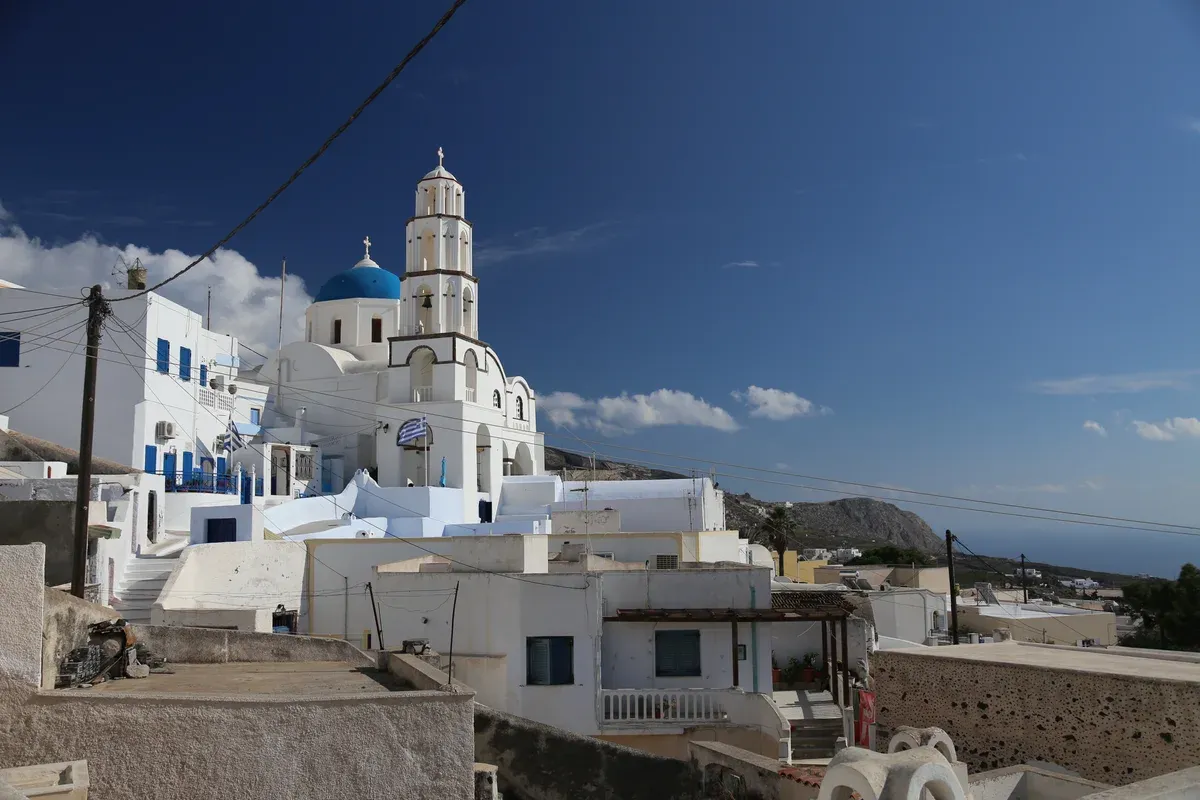
Pyrgos village and its church below the summit. Photo: logopop, CC BY-SA 3.0, via Wikimedia Commons
Pyrgos
Pyrgos, or Pyrgos Kallistis, is an inland hilltop village laid out as a ring of lanes climbing to a Venetian castle mound. From the top you read the whole island at once: the caldera rim to the west, the flat vineyard country below, and the black headland of Mesa Vouno to the east. It stays working and local through the season while the rim villages empty into tour groups.
Buses reach it from Fira for $2.46 (€2.20). See Pyrgos and, if one summit is not enough, Santo Wines pours caldera-view tastings just below.
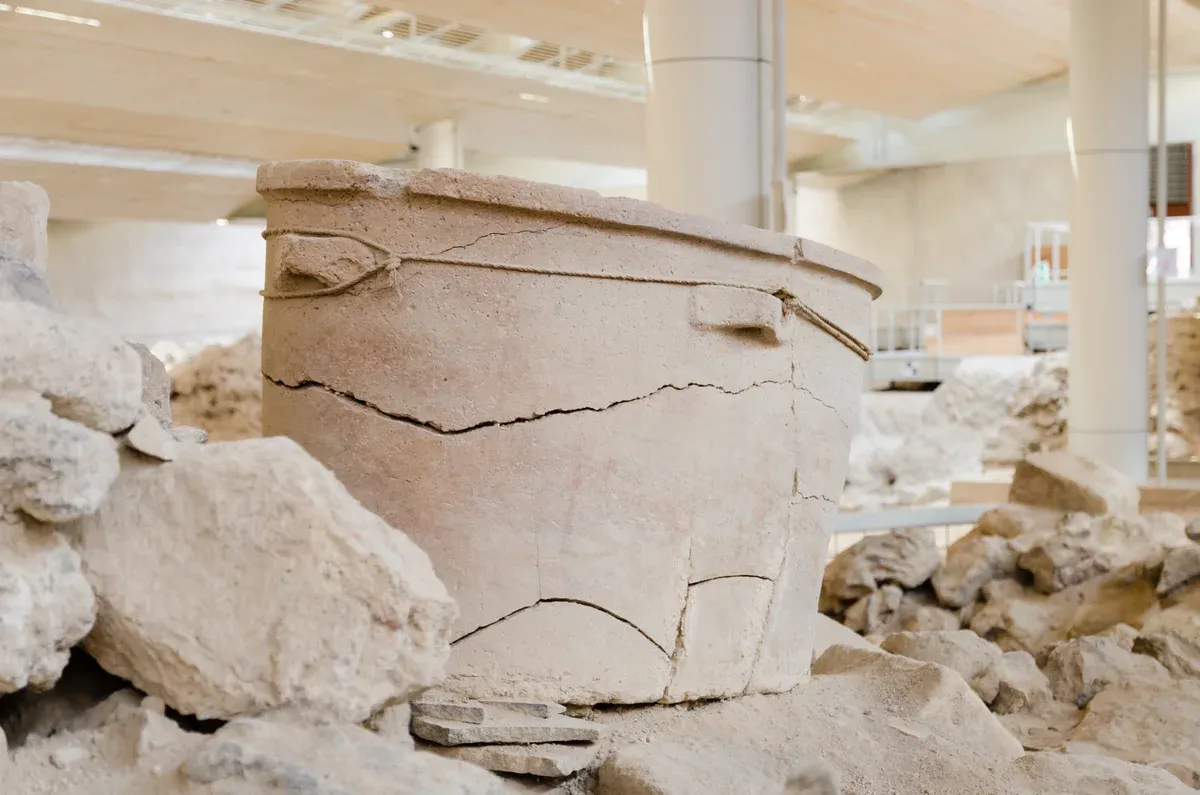
Storage jars in the excavated houses at Akrotiri. Photo: Norbert Nagel, CC BY-SA 3.0, via Wikimedia Commons
Akrotiri
Akrotiri is the reason archaeologists come to Santorini. The Theran eruption of around 1600 BC buried a prosperous Bronze Age port town in ash, preserving multi-storey houses, sewers and wall paintings, one of the largest volcanic events in human history. Excavation began in 1967 under Spyridon Marinatos and continues under Christos Doumas.
Admission is $22.40 (€20), reduced $11.19 (€10), under a modern protective roof. Mondays and Thursdays it closes at 15:30, winter days it closes on Tuesdays, and last entry is 20 minutes before closing. Book a guided Akrotiri walk if the walls alone read as rubble to you.
Red Beach and its cliff at Akrotiri. Photo: C messier, CC BY-SA 4.0, via Wikimedia Commons
Red Beach viewpoint
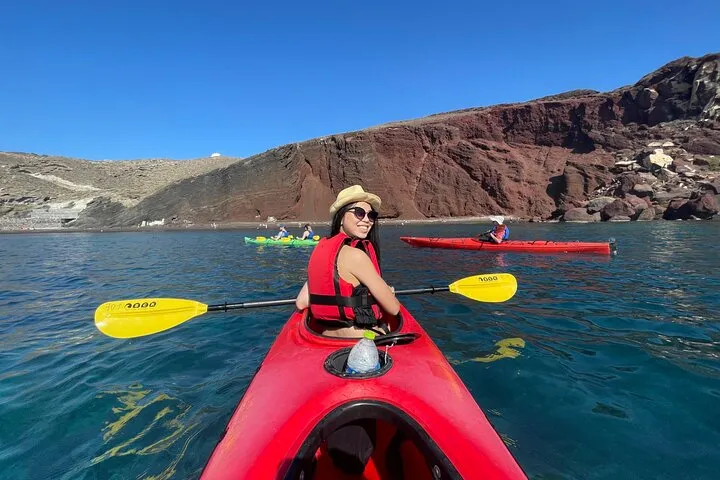
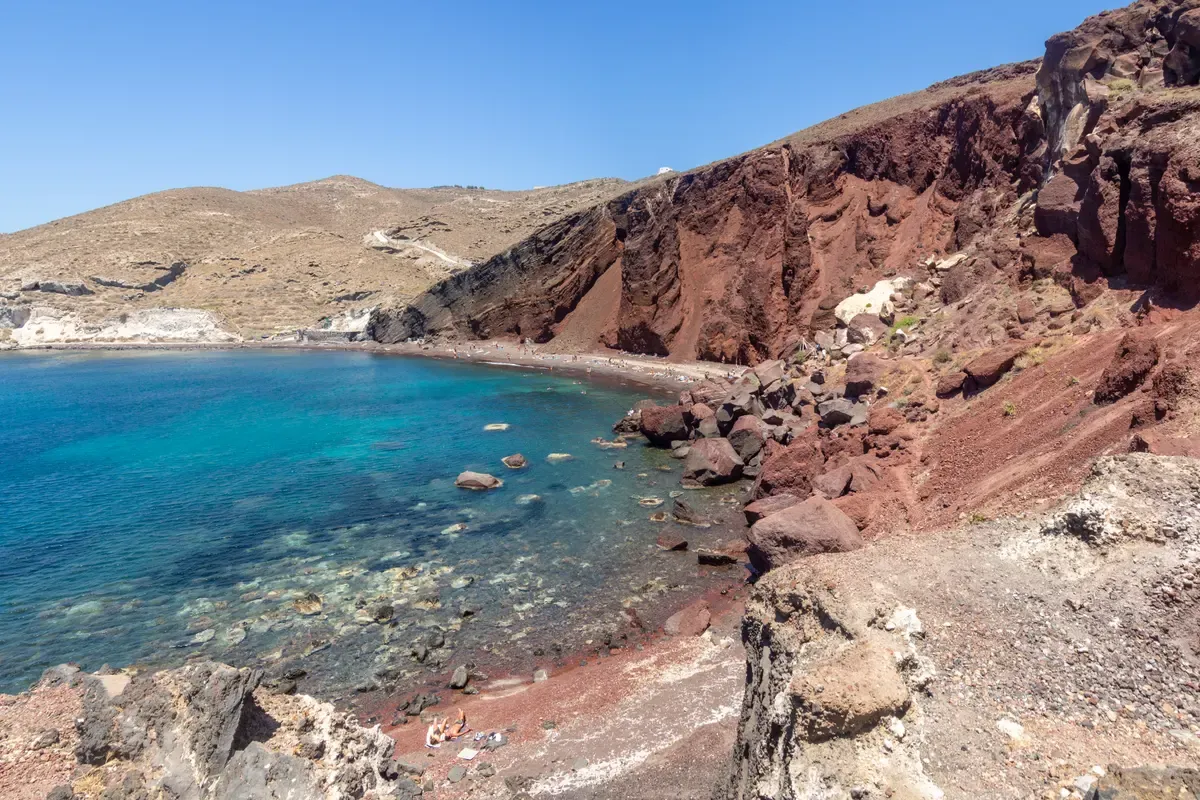
Red Beach at Akrotiri is a cove under a tall iron-red cliff, formed by the same volcanic chemistry that built the caldera. The land path down to it is closed by the municipality for rockfall danger, restrictions that date back years and were hardened after the 2025 earthquake brought rock down onto the beach. The right way to see it now is from the viewpoint above, which costs nothing, or from the water, which many boat tours do.
Read the full story at Red Beach, then continue to the sculpted cliffs of Vlychada beach further south.
The One Decision To Make Before You Fly: Which Boat
A day on the water is the single best-spent booking on Santorini, and the choice between them shapes your whole itinerary. Make it before you arrive, because the summer wind does not care about your plans.
Do you want to stand on the volcano crater, or do you want to swim, eat and let someone else do the walking?
Option
From
Length
Includes
Book
Volcano and hot springs boatFirst-timers who want to stand on the volcano and swim the springs in three hours
$34.32
3 hours
Crater walk with escort, springs swim. €5 park fee on top
The volcano boat routes add the €5 park fee paid on the island. Wind cancellations are real in July and August, so book the water day early in your stay to keep a backup slot. Prices are the platforms' own listings in US dollars. Figures current in Q4 2026.
Tours People Book First
Eight bookings that cover the first decisions of a Santorini trip: a day on the water, the volcano, wine, Akrotiri with a guide, the caldera hike and the ride in from the airport or the ship.
from $148.73
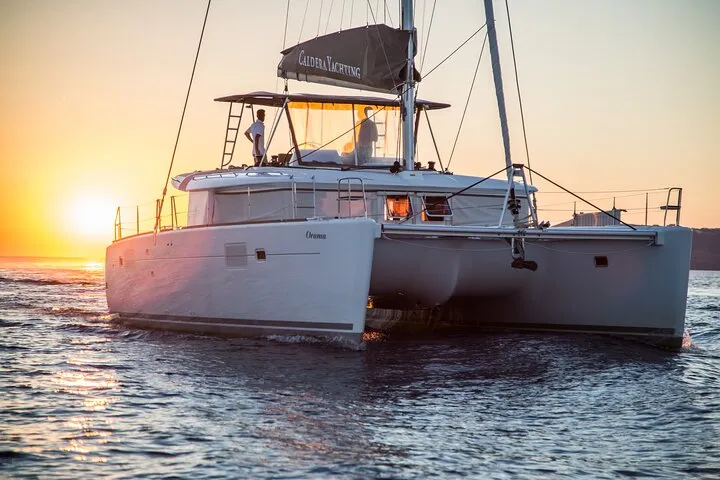
Premium Small-Group Catamaran Cruise with BBQ, Open Bar, Transfer
★★★★★★★★★★4.9(8,080 reviews)· 5 hours
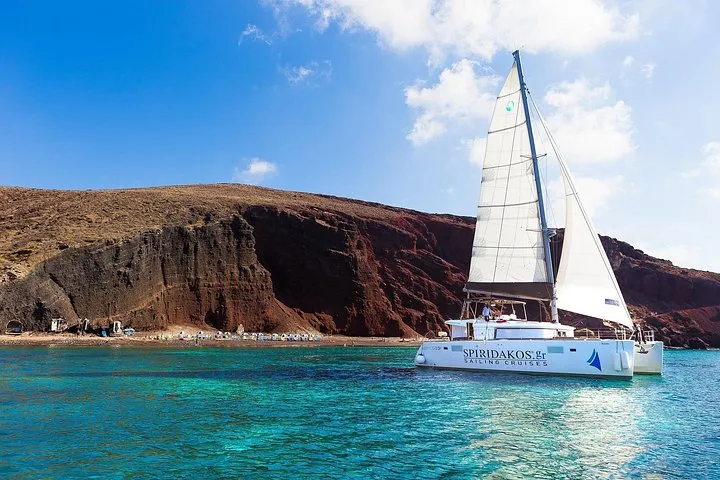
Five hours from Vlychada marina past Red and White beaches and the Akrotiri lighthouse, snorkel stop, BBQ and open bar on board, hotel pick-up included. Small groups of up to 20.
Santorini Volcano and Hot Springs Cruise Tour from Fira Old Port
★★★★★★★★★★4.2(1,318 reviews)· 3 hours
The classic three-hour boat from Fira Old Port to Nea Kameni: 1.5 hours walking the crater trail, then a swim at the warm springs. The €5 volcano fee is paid on top.
Santorini Day Tour: Akrotiri, Villages, Wine and Sunset in Oia
★★★★★★★★★★4.3(1,163 reviews)· 10 hours
The full-day bus tour: Akrotiri with a licensed archaeologist, the black beach, Emporio, Pyrgos and the Oia sunset. The $22.57 added at checkout is the Akrotiri entrance fee (€20).
Santorini Caldera Sunset Traditional Cruise with Meal and Drinks
★★★★★★★★★★4.8(276 reviews)· 5 hours
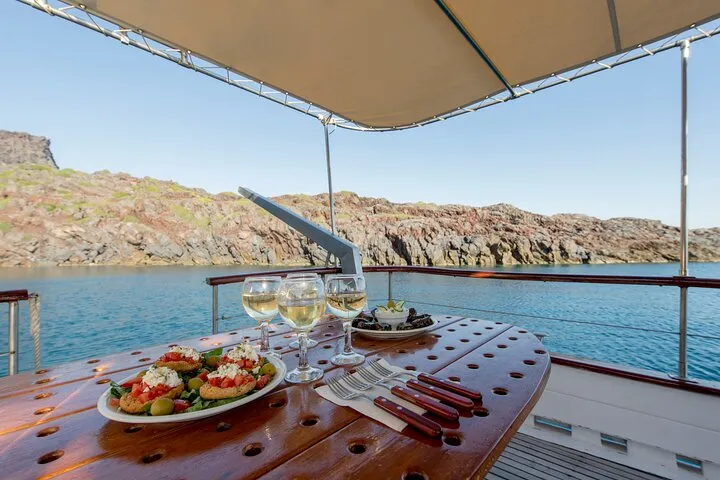
A wooden Greek caique at sunset from Oia and Ammoudi, with Thirassia, the hot springs and a Greek dinner on board. Groups of up to 10; the volcano hike is not included.
SKIP CABLE CAR® Santorini for Cruise Ships with Boat Transfers
★★★★★★★★★★4.8(712 reviews)· 5 hours
Built for cruise passengers: a boat transfer out of the Old Port instead of the cable-car queue, then Oia, the black beach and Megalochori, return to the ship guaranteed.
The island grows its own kitchen in volcanic soil. Eat the local dishes and you are tasting the geology.
The local table
Santorini's cooking rests on fava, a yellow split-pea purée, white eggplants and tiny intense tomatoes, all crops that survive the wind and the poor volcanic soil. Tomato fritters are the classic starter, and the sweet sun-dried Vinsanto wine closes a meal. Read the full repertoire in Santorini food, then choose a table with where to eat in Santorini.
A cooking class
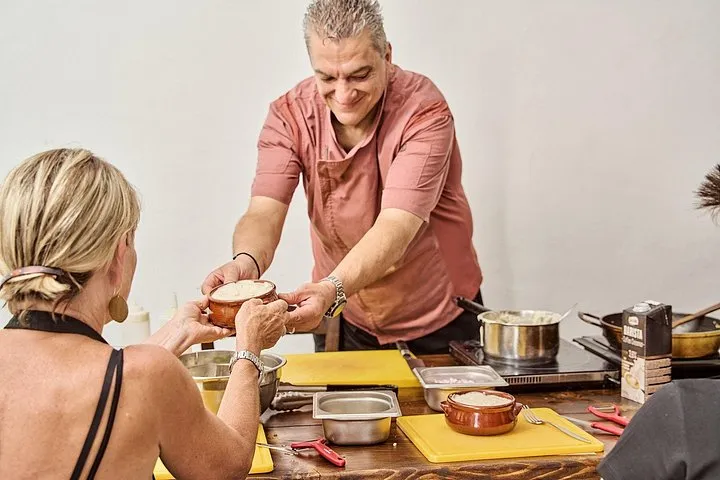
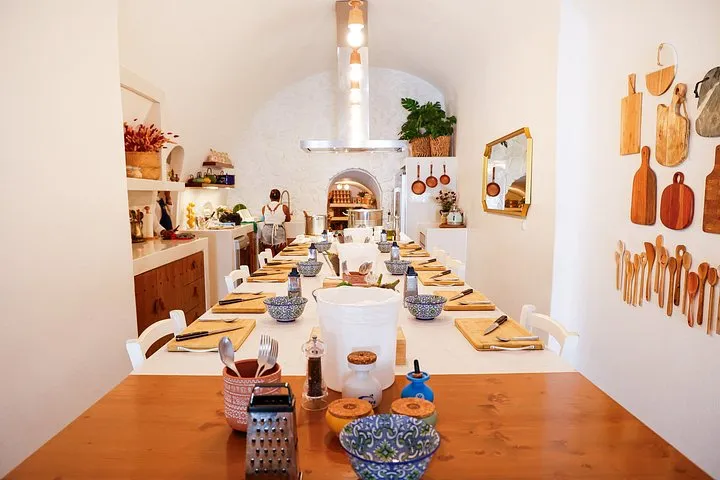
A hands-on class is the fastest way to learn the local larder. This Greek-chef class runs 3.5 hours and covers Greek salad, tzatziki, tomato fritters and pastitsio, ending at a shared table with wine, and it takes vegetarian and gluten-free requests. For something slower, a cooking lesson in a 1920 cave house finishes with a full meal and a recipe book, with no transport provided.
Fira on foot
If a class is too long, eat your way through town instead. A four-hour Fira food walk moves along the caldera path through Fira and Firostefani with tastings at local eateries for groups of up to eight. It doubles as an orientation to the capital, which helps on a first evening before the restaurants thin out into the side lanes.
The Dates That Change The Trip
Santorini shifts character with the calendar more than most islands. Three windows matter.
The summer crush
July and August bring the meltemi, the strong northerly that cancels boat trips and that operators write into their weather clauses. Cruise days queue the cable car and crowd Oia at dusk. Temperatures peak around sea-moderated averages of 26 °C (79 °F), and rain is close to zero.
June and September give the warmest swimming water outside high summer, about 23 °C and 25 °C on the sea record, and October keeps it above 23 °C. October has its own page at Santorini in October, and the archaeological sites step their evening hours down through the autumn, so check Akrotiri tickets before you fix a day.
Winter
From November the sites cut to short days: Akrotiri runs 08:30 to 15:30 and closes Tuesdays, Ancient Thera opens only Fridays to Sundays in November and by appointment in the depth of winter. The wine union's Santo Wines stays open all year. Weather month by month is on Santorini weather.
What Actually Goes Wrong
Five failure points, all avoidable once you know them.
Wind cancels the boats
Mean daily wind maxima run 28 to 37 km/h all year, and the July-August meltemi is the reason boat trips get cancelled. Operators state weather clauses in their terms. Book your water day for the first or second morning of the trip so a cancelled boat has a spare day to fall back on, and read the cancellation terms on Santorini boat tours.
The cable-car queue on cruise days
When several ships tender into the Old Port, the queue for the 3-minute ride up the cliff grows long, and the Karavolades stairs beside it are several hundred steps of the same crush. If you arrive by ship, a shore tour that leaves by boat from the Old Port sidesteps both, such as the skip-the-cable-car day for cruise passengers. Otherwise plan Old Port visits for late afternoon.
The Red Beach path
The land path down to Red Beach is closed by the municipality for rockfall danger, restrictions hardened after the 2025 earthquake dropped rock onto the beach. Reports since say the cove is reachable only by water. Do not plan a walk down.
Greek law requires a licence valid for the engine size, and above 50 cc that is a motorcycle category. Many renters accept a car licence anyway, which can leave the rider uninsured in a crash. Non-EU licences also need an International Driving Permit.
A 2026 government draft would require five years of car-licence experience for ATV rentals, but it is a proposal, not law. The details sit in Santorini car rental.
Akrotiri's short days
Mondays and Thursdays Akrotiri closes at 15:30 all year, hours step down through autumn, and it closes entirely on Tuesdays in winter, with last entry 20 minutes before closing. Arrive at three on a Thursday in November and you will read the gate sign, not the town. Fix the day against the table on Akrotiri tickets and put the beach on the short day instead.
Santorini Month By Month
The month-by-month chart below uses ERA5 reanalysis data, which reads the island's sea-moderated averages rather than a land thermometer, so daytime highs run a couple of degrees under what you feel in Fira.
12.8°C55°F
JanuaryJan
13.1°C56°F
FebruaryFeb
14.3°C58°F
MarchMar
16.7°C62°F
AprilApr
20.1°C68°F
MayMay
24°C75°F
JuneJun
26.1°C79°F
JulyJul
26.2°C79°F
AugustAug
24.1°C75°F
SeptemberSep
20.7°C69°F
OctoberOct
17.5°C64°F
NovemberNov
14.5°C58°F
DecemberDec
Sea at 22 °C or warmer
Meltemi months, boat days at risk
Akrotiri on long summer hours (to 20:00)
Wettest stretch, 41 to 60 mm a month
Open-Meteo ERA5 reanalysis, 1995-2024, at 36.42 N, 25.43 E. The grid cell is mostly sea, so highs read 2-3 °C under a thermometer in Fira.
Santorini Weather And Sea, Month By Month
The table adds the numbers the chart hides: lows, rainfall in millimetres, rain days and the sea temperature by month, all from the same 30-year record.
Month
High / low
Rain
Rain days
Sea
January
12.8°C / 9.9°C
60 mm
10.9
17.8°C
February
13.1°C / 10.0°C
57 mm
8.8
17.1°C
March
14.3°C / 11.0°C
41 mm
6.5
17.1°C
April
16.7°C / 13.0°C
15 mm
3.5
17.7°C
May
20.1°C / 16.3°C
10 mm
2.0
19.3°C
June
24.0°C / 20.2°C
2 mm
0.6
22.7°C
July
26.1°C / 22.4°C
0 mm
0.1
24.6°C
August
26.2°C / 22.9°C
1 mm
0.3
25.9°C
September
24.1°C / 20.9°C
6 mm
1.1
25.1°C
October
20.7°C / 17.6°C
20 mm
3.5
23.1°C
November
17.5°C / 14.4°C
32 mm
5.7
21.1°C
December
14.5°C / 11.6°C
55 mm
9.4
19.0°C
Air: Open-Meteo ERA5, 1995-2024. Sea: Open-Meteo Marine, daily mean sea-surface temperature 2021-2025 inside the caldera. Rain days count days with 1 mm or more. Month by month detail is on Santorini weather.
Getting Around An Island This Size
Santorini is small enough that transport is a simple choice, and cheap enough that it should not stress your budget.
The KTEL bus
The public network radiates from the Fira bus station. Fira to Oia is $2.46 (€2.20) for 11.8 km, Fira to Perissa or the Athinios ferry port is $3.02 (€2.70), and Fira to Vlychada is $3.13 (€2.80). The airport line is $2.46 (€2.20).
Pay the conductor on board, and treat the timetable as seasonal: departure times live in the KTEL PDF rather than anywhere fixed. Full routes at getting around Santorini.
The Fira cable car
The cable car links Fira to the Old Port every 20 minutes, one way $11.19 (€10), children and luggage $5.59 (€5). Summer hours run 07:00 to 23:00, and the machine carries 1,200 people an hour, which still is not enough on multi-ship cruise days. The stair alternative is several hundred steps each way, and the mule path shares the ticket revenue with the drivers.
Car, quad or nothing
A rental buys the south coast, the wineries and the inland villages on your own clock. The catches are the licence rules: above 50 cc a quad needs a motorcycle category, and non-EU drivers need an International Driving Permit. Roads are narrow and parking in Oia is scarce in season.
Weigh it up in Santorini car rental before you pay for a vehicle you will park more than drive.
What Santorini Costs Per Day
The island is expensive at the top and modest at the bottom. Here is where the money actually goes.
The fixed costs
Entry fees are gentle: Akrotiri $22.40 (€20), Ancient Thera and both Fira museums $11.19 (€10) each, and the volcano park adds a €5 fee on the island on top of most boat tickets. A full archaeological day costs less than one caldera-view dinner. Free days exist at Akrotiri, including the first and third Sunday of each winter month.
Every stay adds the climate crisis resilience fee, per room per night from April to October: €2 for 1-2 star, €5 for 3 star, €10 for 4 star, €15 for 5 star and villas, €8 for short-term rentals, paid at the property. It is charged on top of the room rate, so budget it. Winter rates are lower, from €0.50.
Buses cap daily transport at a few dollars: Oia out and back is $4.92 (€4.40). Cruise passengers pay a separate disembarking fee of €20 in high summer, €12 in the shoulder months, usually passed on through the cruise line. Ferries from Athens vary by date and seat, so no figure belongs here.
Winery tasting prices are listed on each winery's booking page. Compare everything at Santorini costs.
Tuesday And Wednesday: The Closing Days
Two weekdays close two different museums. Fix your itinerary around them.
Tuesday
The Museum of Prehistoric Thera in Fira, home of the Akrotiri frescoes, is closed on Tuesdays. Akrotiri closes on Tuesdays in winter, from November to March, though it opens the other winter weekdays on short 08:30 to 15:30 hours. Plan the south-coast or beach day on a Tuesday and keep Fira for a different morning.
Ancient Thera, the Dorian city on Mesa Vouno above Kamari and Perissa, closes every Wednesday in summer, entry $11.19 (€10). The site also keeps short 08:30 to 15:30 hours, so it is a morning stop, not an afternoon one. Winter access narrows further: November runs Fridays to Sundays and deep winter is by appointment.
Pair it with the beaches via Kamari on any other day.
Days On The Water And Beyond
The caldera itself is the best day trip, and the neighbouring islands fill the rest of a long stay.
from $40.04
Santorini Caldera Cruise Tour (Volcano, Hot Springs, Thirassia)
★★★★★★★★★★4.4(1,439 reviews)· 6 hours
Six hours on the water: the Nea Kameni crater walk, the hot springs swim and a stop on Thirassia. Pick-up from Athinios port is an option; the €5 volcano fee is extra.
Prices, ratings and details are the platform's own. dollar figures are the listed prices — the platform bills in your account's currency.
Pick A Village Before A Hotel
The district decides your trip more than the hotel does. Four kinds of base, four kinds of stay.
Caldera villages
Oia, Imerovigli and Firostefani hold the classic cave-house stays, carved into the cliff with terraces over the caldera. The view is the product and the price follows it, with a €15 resilience fee at the top end for villas. Walks and sunsets are on the doorstep, but buses to the south all route through Fira.
The capital is the practical middle: the bus station, the museums, the cable car and the widest restaurant choice within walking distance. Rooms cost less than the smaller rim villages because views are partial. It is loud on cruise days and lively at night, which is either the point or the problem.
Kamari, Perissa and Perivolos trade the caldera view for a long dark-sand beach and the island's cheapest good beds, a $3.02 (€2.70) bus from Fira. Families and swimmers do best here, and Ancient Thera stands right above Kamari for one early morning. Sunset means the wrong side of the island, so pick this base with your eyes open.
Pyrgos, Megalochori and the wine country around them offer village life, cellar doors and lower prices, with everything a short drive away. This is the base for people who have seen the caldera before, or who came for the wine rather than the postcard. Buses cover Pyrgos and Megalochori from Fira for $2.46 (€2.20).
The 2025 earthquake swarm, more than 12,800 tremors with the largest around magnitude 5.2-5.3, subsided in spring and the volcano itself did not erupt. Safety on the island
Could the volcano erupt again?
The Kameni islands were built by eruptions over two millennia, the last a small lava dome in 1950, and the great Minoan eruption around 1600 BC destroyed Akrotiri. The 2025 swarm produced no eruption. The mechanics are explained at the earthquake record. The volcano's history
How do I get in from the airport?
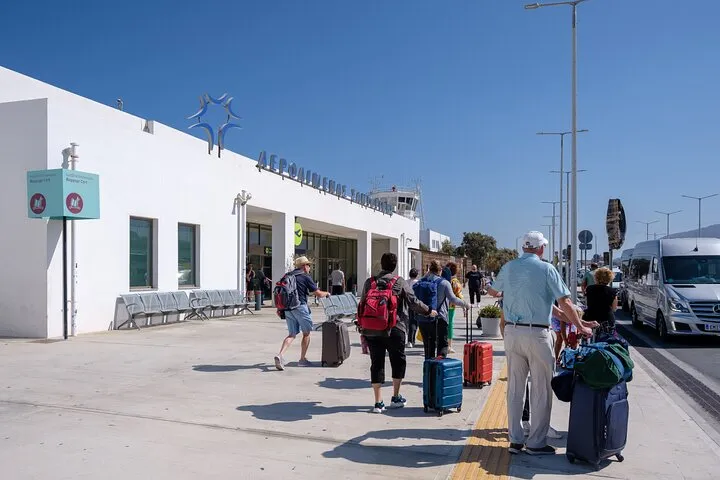
Santorini airport sits about 6 km southeast of Fira, on the Fira-Kamari-Monolithos bus line for $2.46 (€2.20). Shared and private transfers meet flights as well. Routes are compared on the airport page. Airport to Fira
What is the ferry from Athens like?
From Piraeus, high-speed ferries run roughly 4 hours 50 minutes to 5 hours 35 minutes and conventional boats about 7 hours 30 minutes or more. Fares vary by date and seat, so we print none. The options are laid out at Athens to Santorini. Ferries from Athens
Where do cruise ships dock?
Cruise ships anchor in the caldera and tender passengers to the Old Port below Fira, where the cable car and the long stairway climb the cliff. The disembarking fee runs from €4 to €20 by season. Timing and tender detail are on the cruise port page. The cruise port
Is Santorini expensive?
The rim villages and sunset dinners are expensive, while entry fees, buses and the black-beach side are not: Akrotiri is $22.40 (€20) and the Oia bus is $2.46 (€2.20) each way. Add the nightly resilience fee of up to €15 at 5 star level. The full ledger is on the costs page. What it really costs
Is Santorini good with kids?
The black beaches, the cable car ride and the volcano boat trip all work well for children, and the island's short distances keep transfer days painless. The caldera villages are all steep steps, so base choice matters with a pushchair. Family detail is on the kids page. Santorini with kids
Questions About Santorini, Greece
Why is Santorini famous?
Two things: the caldera, a flooded volcanic collapse basin with villages perched 220 m above it, and the Minoan eruption of around 1600 BC, one of the largest volcanic events in human history, which buried the Bronze Age town of Akrotiri. The views at Oia and the ruins at Akrotiri are the two sights that made the name.
Is Santorini very expensive?
It is expensive where the view is. A caldera-view room carries the highest resilience fee band at €15 a night, while buses cost $2.46 (€2.20) to $3.13 (€2.80) and the archaeological sites cost $11.19 to $22.40 (€10 to €20). The arithmetic is on the Santorini costs page.
How many days in Santorini is enough?
Three days fits the island honestly: one for the rim and Oia, one for Akrotiri and the south, one on the water. Two days forces a choice between the volcano trip and the beaches, and one day is a highlights sprint. Plans for each length are in Santorini in 3 days, or start shorter with Santorini in 2 days.
Do they speak English in Santorini?
Yes, widely. Greek is the island's language, but English is spoken throughout the tourism trade, from the KTEL conductor to the cable car gate, so visitors manage without Greek. Emergency services answer 112.
June and September give a sea of about 23 to 25 °C without the July-August meltemi peak that cancels boats. October still reaches sea-moderated highs near 21 °C (69 °F). Month by month, see Santorini weather and the best time to visit Santorini.
Do I need to rent a car?
No, not necessarily. The KTEL buses reach Oia, the airport, the ferry port and both black beaches from Fira for under $3.02 (€2.70), and the rim villages you walk. A car earns its cost only for wineries and the inland villages. Both options are weighed in getting around Santorini and Santorini car rental.
How do I get to Santorini?
Fly into Santorini airport (JTR), about 6 km southeast of Fira, or take a ferry from Piraeus: high-speed boats take about 4 hours 50 minutes to 5 hours 35 minutes and conventional ships about 7 hours 30 minutes or more. Cruise passengers land by tender at the Old Port below Fira. The routes are compared on Athens to Santorini and Santorini airport.
Santorini On Video
Short videos below put you on the rim path, the volcano trail and the Oia sunset before you book anything.
Santorini Beginner’s Guide [ALL THE BASICS in 5 min]
The island in five minutes: villages, transport and the basics, a good first orientation.
Video: Greece Explained
SANTORINI TRAVEL GUIDE & COST 🇬🇷 GREECE
Costs, villages and a route around the island, useful before you pick a base.
Video: Jumping Places
Santorini FOR FIRST-TIMERS in 2026 | 14 MISTAKES to Avoid & Must Know Tips
Mistakes first-timers make, from the cable-car queue to sunset timing.
Video: thelittlebasket
Videos load from YouTube only when you press play.
Book The Boat Day First
The day on the water is the booking most worth making early, because the summer wind cancels sailings and a spare day keeps your trip intact.
Tour prices are the platforms' own listings. Entry fees, fares and opening days come from the official sites.
These are not our contact details. The website above is Visit Greece, the official site of the Greek National Tourism Organisation, with its page on Santorini. Santorini Island Guide is an independent site: to reach us, use our contact page.
 Santorini Island Guide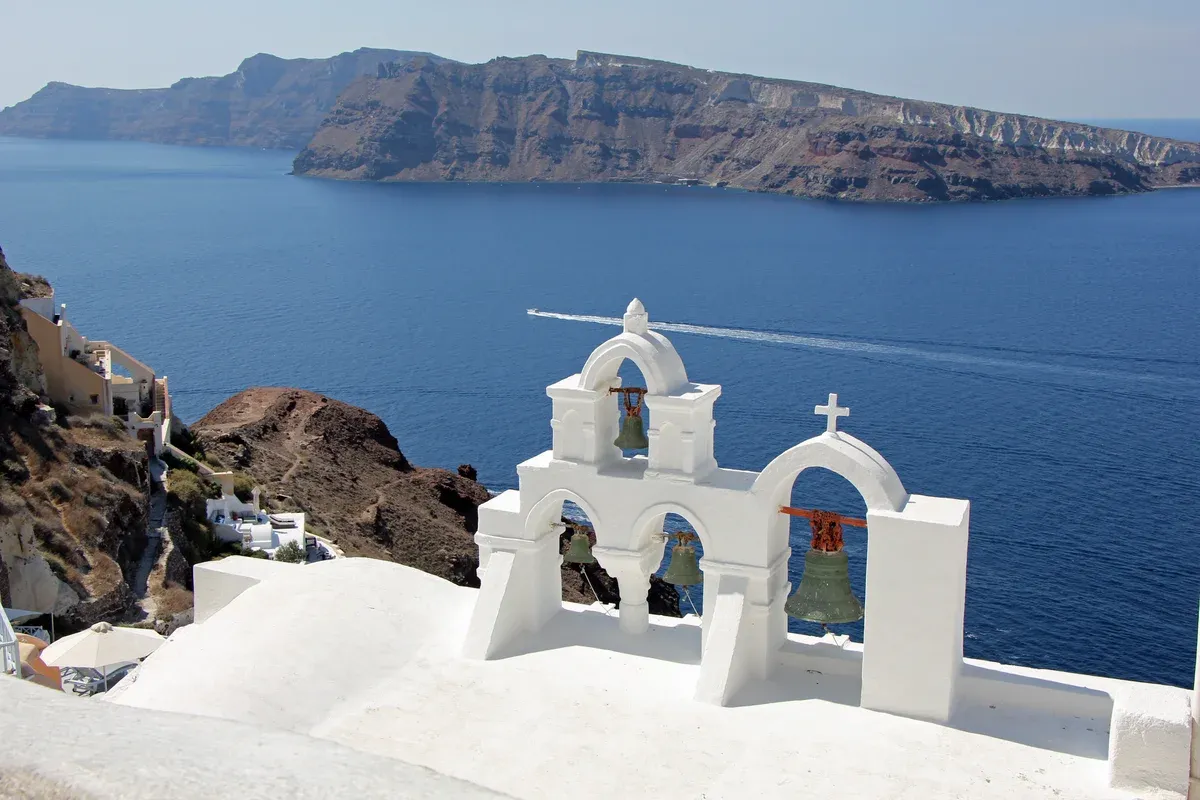
 from $148.73