 Santorini Island Guide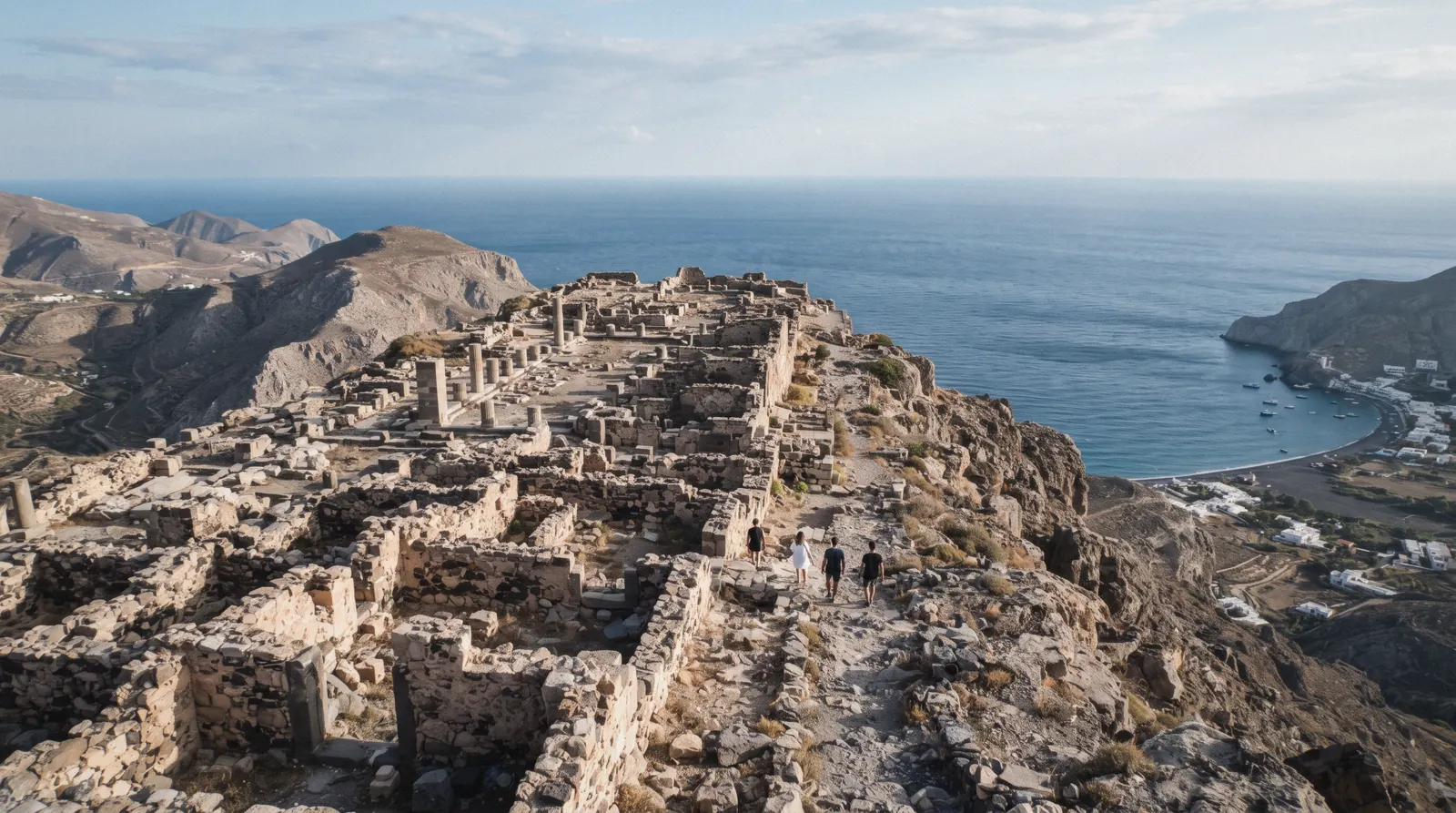
Ancient Thera is the ruined Dorian city on top of Mesa Vouno, the headland that separates Kamari from Perissa beach. It is the only place on Santorini where you can walk a full classical city with the sea on two sides, and entry costs $11.19 (€10). This page covers the climb, the ruins, the hours and how it fits a day. It is part of our Santorini, Greece travel guide.
Quick answer Ancient Thera in short
Ancient Thera is a Dorian city founded in the 9th century BC on the summit of Mesa Vouno, between Kamari and Perissa. It opens 08:30-15:30 in summer, closes on Wednesdays, and entry is $11.19 (€10), reduced $5.59 (€5). The Ephorate puts the average visit at 1.5 hours, before the steep walk up.
Key takeaways
- Entry is $11.19 (€10) reduced $5.59 (€5), and the site shuts at 15:30, so go early. See Santorini tickets.
- Closed Wednesdays in summer, with tight winter windows. Plan around it with Santorini travel tips.
- Reach it by the winding road from Kamari or a footpath from either side. Details in getting around Santorini.
- Prefer someone else to drive? Compare Santorini tours that cover the south of the island.
Key facts
Opening hours
| Summer (Apr-Oct) | 08:30–15:30 |
|---|---|
| November | 08:30–15:30 |
| December-February | by appointment–by appointment |
| March | 08:30–15:30 |
Closed Closed Wednesdays in summer and on public holidays. November: Fri-Sun only. December-February: by appointment only. March: Thu-Mon.
Admission
- Adult
- $11.19 (€10)
- Reduced
- $5.59 (€5)
- Free
- First Sunday Nov-Mar per the Ephorate page
Planning it
- Time needed
- Not stated officially beyond the Ephorate's average duration of 1.5 hours. Our routing allows 2 hours with the climb
- Book ahead
- Optional — walk-up usually fine
- Address
- Mesa Vouno, above Kamari, Santorini 847 00, Greece
Entry and tickets compared
This table compares the ways to see Ancient Thera: the official entrance ticket you buy on the spot, and the guided day tours from our listings that cover the island's south, where Ancient Thera is the natural stop.
Do you want to walk the ruins on your own, or fold them into a guided day with transport handled?
| Option | Price | Length | Includes | Book |
|---|---|---|---|---|
| Official entry ticket, bought at the site | $11.19 (€10), reduced $5.59 (€5) | Average visit 1.5 hours per the Ephorate | Access to the ruins, no guide, no transport | Official site |
We sell no tour that includes the Ancient Thera gate itself, so the official row is the honest entry option. The full-day listings below cover the island around it. Figures current in Q4 2026.
Tours that pair well with Ancient Thera
None of these listings walks the ruins with you, but each covers the south coast, the beaches or a full circuit where Mesa Vouno sits in the middle of the day.
 from $58.02
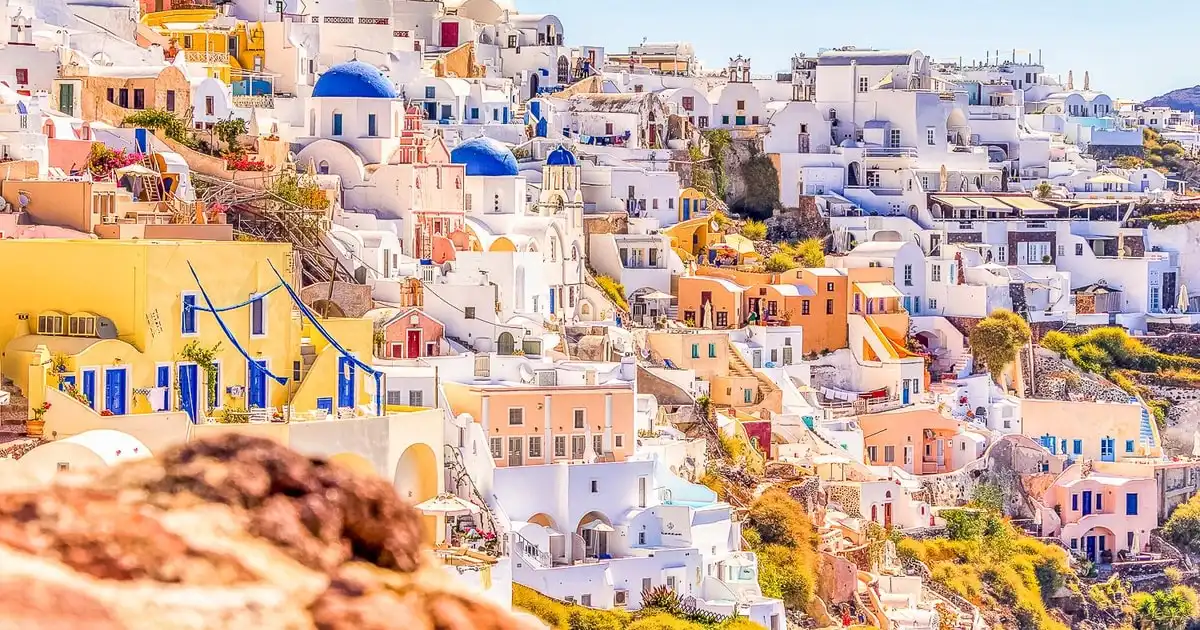
Top Sights Day Trip, Wine Tasting, & Oia Sunset
A nine-hour coach day: the top sights, a winery stop and the Oia sunset, with pick-up and a private option.
Check Availability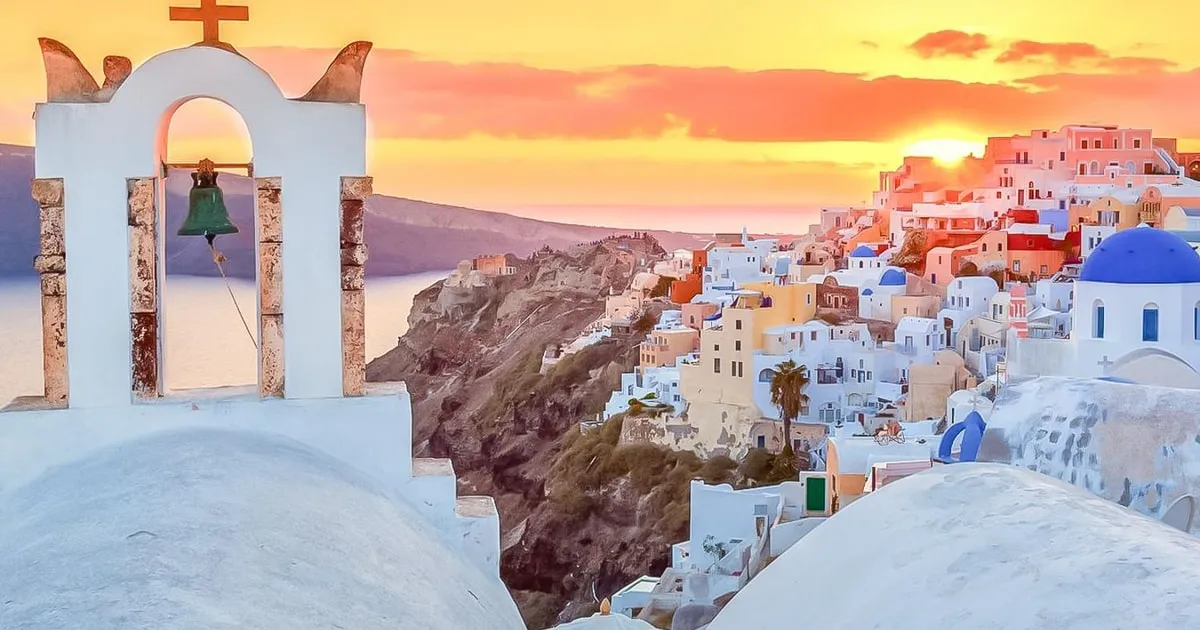 from $59.53
Traditional Sightseeing Bus Tour with Oia Sunset
The classic sightseeing bus day with the Oia sunset, ten hours with pick-up.
Check Availability from $67.50
Santorini Day Tour: Akrotiri, Villages, Wine and Sunset in Oia
The full-day bus tour: Akrotiri with a licensed archaeologist, the black beach, Emporio, Pyrgos and the Oia sunset. The $22.57 added at checkout is the Akrotiri entrance fee (€20).
Check Availability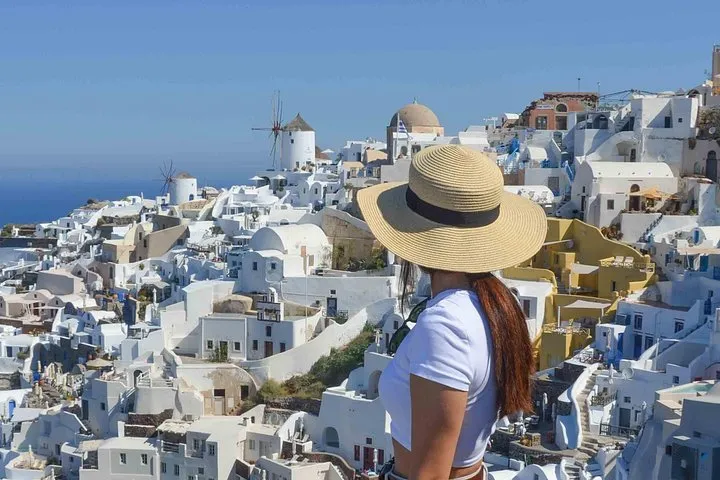 from $62.92
Santorini Highlights Small-Group Tour with Wine Tasting option
A highlights tour in a small group: Oia, the Profitis Ilias viewpoint and the villages. The listing adds $22.57 at checkout and excludes the €20 wine tasting and the Akrotiri entrance.
Check Availability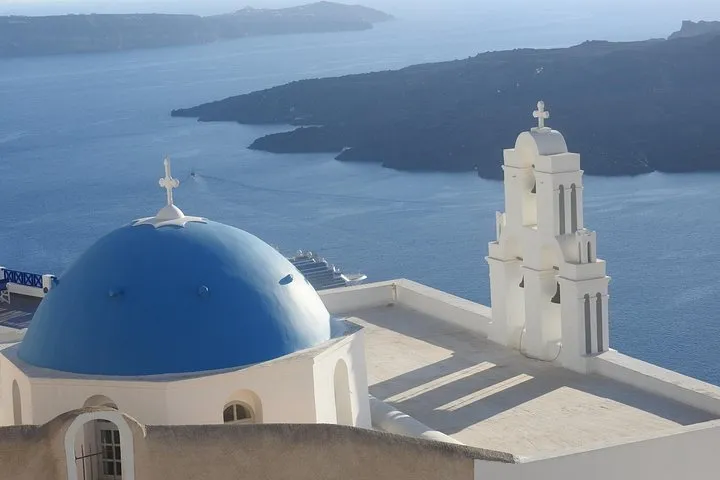 from $66.93
Santorini Half-Day Small Group Tour: Villages, Oia, Caldera Views
A half-day small group of up to 18: Profitis Ilias for the island view, Megalochori, the Firostefani blue dome and Imerovigli, with hotel pick-up.
Check Availability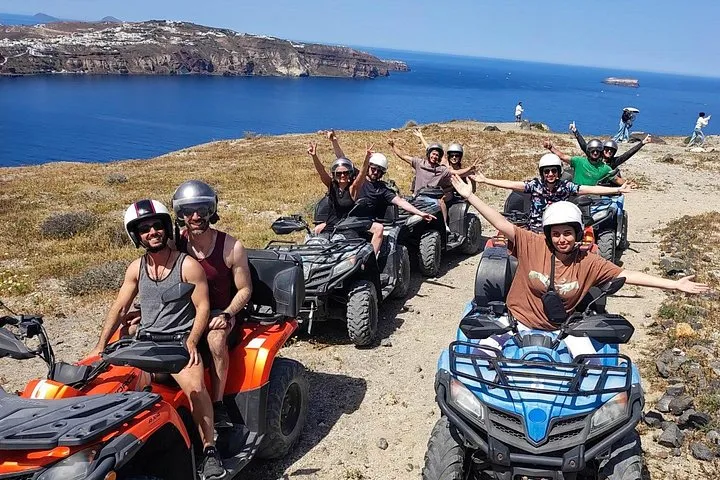 from $148.73
Santorini ATV Experience | Off-Road, Secret Places & FREE Pickup
A guided ATV convoy on off-road tracks from Perissa through Emporio and the south, morning or sunset, fuel and insurance included.
Check Availability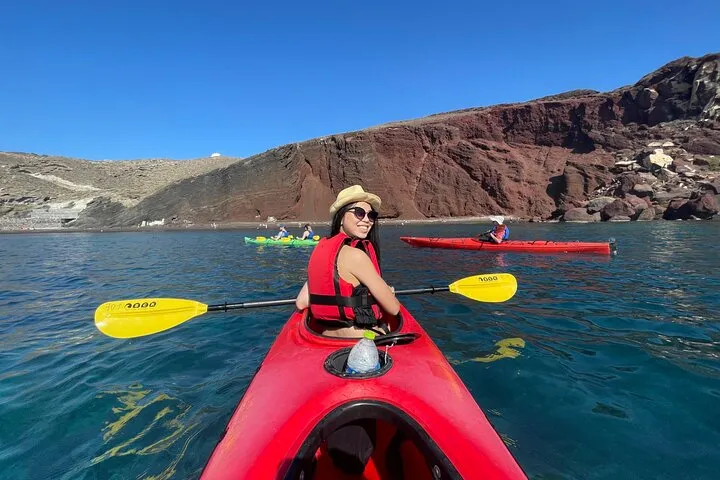 from $143.01
Santorini Kayak in Volcanic Cliffs Hidden Sea Caves and Picnic
Three hours paddling the south coast past the Red and White beaches with snorkelling and a picnic, guided by certified instructors.
Check AvailabilityPrices, ratings and details are the platform's own. dollar figures are the listed prices — the platform bills in your account's currency.
What Ancient Thera is, and who built it
The site has three layered stories: a Dorian foundation, a Hellenistic and Roman town, and a century-old excavation.
A Dorian city above two seas
Spartan colonists from the Dorian branch of the Greeks founded Thera on the ridge of Mesa Vouno in the 9th century BC. The hill rises between Kamari and Perissa, so the city commanded the island's two south-eastern bays at once. For centuries this ridge, not the caldera rim, was the urban heart of the island.
The choice looks severe today, with no spring on top and a climb for every jug of water. It made military sense. From the summit you can watch both coastlines, and the cliffs make assault hard. The city stayed here until the Hellenistic and Roman periods, when life shifted and Ptolemaic garrisons also used the ridge.
- Founded in the 9th century BC by Dorians
- Position chosen for control of the two bays
- Later used in the Hellenistic era, including by Ptolemaic forces
From ruins to excavation
The city faded in antiquity and the ridge stayed empty until the archaeologist Hiller von Gaertringen excavated it between 1895 and 1904. German work cleared the streets, temples and houses you walk through now. Because the city was abandoned rather than buried by the volcano, what you see is broken stone in the open air, not the preserved rooms of Akrotiri Santorini.
That difference matters for planning. Ancient Thera is a classical city with two millennia of continuous use. Akrotiri is a Bronze Age town frozen by the eruption of circa 1600 BC, a story told at length in our minoan eruption guide. They are not substitutes for each other, and the entry prices differ too, with Akrotiri at $22.40 (€20) against $11.19 (€10) here. Our comparison of the two sites picks between them.
Why the name Thera
Thera is the ancient name of the island itself, given by the Dorian founder Theras, and the modern capital's name, Fira, is a variant pronunciation of the same word. The island was called Thera for most of its recorded history before the Latin name Santorini spread from a chapel of Saint Irene. So the site is not named after the town.
The town, and the island, are named after the site's founder, which is why 'ancient thira' and 'Ancient Thera' both point to the same ruins on Mesa Vouno.
What you see up there
The site is a full small city: a sanctuary quarter, two agoras, streets, houses and a theatre, all open to the sky.
The sanctuaries at the top
Near the summit stands the sanctuary of Apollo Karneios, the chief god of the Dorian calendar, whose gymnasium served the city's youth. Higher still is the sanctuary of Athena, patron of the foundation, with a temple platform that later Christian use overlaid. The ridge-top position gave these cults the whole horizon, from Anafi on clear days to the island's interior.
Give the sanctuaries about half an hour. Signage is sparse, so a guidebook or our Santorini map helps. Afternoon light flattens the stones, which is one more reason the early shift from 08:30 works better for photography.
Streets, agoras and the theatre
Below the sanctuaries the city grid opens up: the stone-paved main street, the Hellenistic agora framed by stoas, and a small rock-cut theatre that used the slope for seating. Roman-era houses and bath buildings fill the gaps between. Carvings on the rocks, including inscriptions and homoerotic figures cut by sailors centuries ago, are some of the most discussed finds at the site.
Walk the main street end to end. It is the fastest way to grasp the scale of the place, and it delivers the two-coast panorama the founders wanted. The Ephorate's average visit of 1.5 hours covers a steady circuit of all of this. Add time for the Theatre viewpoint, our pick for the best single photo of the Perissa shoreline.
The view that explains the site
From the walls you look one way to Kamari Santorini with its long black beach and the airport beyond, and the other way to Perissa and the southern coast. This is the clearest place on the island to understand its geography as one ridge with two slopes, not just a caldera rim. It also puts the Santorini caldera in context: the classical city never lived on the caldera edge at all.
Wind is constant on the exposed summit, and the July and August meltemi can push hard. Bring a layer even on a hot day. The site is bare shade-free stone, so a hat and water are not optional in summer.
Hours, seasons and the quiet slots
Ancient Thera has the tightest opening pattern of any major sight on the island. Get the window wrong and the gate is shut.
The official timetable
In summer the site opens 08:30 and closes at 15:30, and it closes all day every Wednesday. November runs the same hours but only Fridays to Sundays. From December to February access is by appointment only, which means you contact the Ephorate ahead. March runs Thursdays to Mondays. Public holidays close the site, and the first Sunday from November to March is a free-admission day per the Ephorate page.
There is no evening opening, ever. Unlike Akrotiri, which stays open to 20:00 in high summer, the ridge shuts early. If your day is built around a sunset in Oia Santorini, Ancient Thera has to come first, not last.
Choosing your slot
Our estimate for the quietest hour is 08:30 to 09:30, before the beach crowds of Kamari and Perissa think about culture. The mid-morning brings the first hikers up from Perissa and cars up the Kamari road. By 13:00 the heat on bare stone is serious in summer, and the 15:30 close leaves no slack.
The shoulder months are the sweet season. April, May, late September and Santorini in october give you cooler stone, green slopes after the winter rains and easier parking. Check Santorini weather and the best time to visit Santorini before fixing the day, because a strong meltemi turns the exposed summit into hard work.
Wednesdays, holidays and winter
Wednesday closures catch out more visitors than any other detail. If your island week includes a Wednesday beach day in Kamari, move the ruins to another morning. In December to February, when the site takes visitors by appointment, treat it as a planning exercise rather than a turn-up option and allow days of notice.
The winter windows are thin for a reason: the road and paths ice in the morning shade and the Ephorate runs a reduced staff. If Ancient Thera is a priority and you are travelling off-season, our Santorini itinerary page shows how the other museums, open 08:30-15:30 in Fira, fill the same cultural slot indoors.
Getting to the top of Mesa Vouno
There are three ways up: the winding paved road from Kamari, a footpath from Kamari, and a footpath from Perissa. All end at the same gate.
By road from Kamari
A narrow paved road switches up the Kamari flank of the mountain to a small parking area below the entrance. Hiring a car or an ATV makes this the easy option, and you can continue over or back down to the beaches afterwards. See Santorini car rental and the insurance warnings there before you book a quad. Drive times are our estimate: about 15 minutes from central Kamari up to the parking, in low season traffic.
A taxi is possible but there is no rank at the gate, so agree a return pickup in advance. Walk times in this guide are our estimate. Do not leave anything visible in the car, the parking is small and unattended.
On foot from either side
Footpaths climb to the summit from both Kamari and Perissa. The Perissa side starts near the waterline at the foot of the mountain, which makes it popular with beachgoers who want the walk before a swim. The Kamari side can start from the road or the old zigzag path. Both are steep, shadeless and best before 10:00, and in summer carry more water than seems reasonable.
The walk up takes our estimate of 45 minutes to an hour from either village, on top of the Ephorate's average visit of 1.5 hours inside. Sturdy shoes beat sandals, because the paths mix stone steps with loose rock. Hikers continuing the long way round can connect to island routes described in Fira to Oia hike, though that is a separate day.
By bus, with a walk or a ride
The KTEL bus hub is in Fira Santorini, with lines to both Kamari and Perissa. Fira to Kamari costs $2.46 (€2.20) and Fira to Perissa costs $3.02 (€2.70), paid to the conductor on board. Departure times are seasonal and published only in the KTEL PDF, so check them the night before rather than trusting memory.
From the bus stops at either village you take the footpath or a local ride to the gate. The bus plus walk is the cheapest route up and the one we would choose without a car, since the buses run often along both beach roads in summer. Full routes and fares sit on our getting around Santorini page.
How much time to give it, three routings
The Ephorate's own average visit is 1.5 hours. What changes your day is how you arrive, so here are three routings with the time each one really takes.
Three ways to build the visit
The routing decides everything: beach morning, hike morning or drive-through morning. All three end at the same gate, and all three should start before 10:00 in summer.
| Routing | Time needed | Best for |
|---|---|---|
| Bus from Fira to Kamari, footpath up, visit, bus back | About 3.5 hours door to door (our estimate) | No-car travellers who want the cheapest day |
| Stay in Kamari or Perissa, walk up early, visit, beach after | About 3 hours including the climb (our estimate) | Beach-week guests who want culture before the heat |
| Drive or ATV to the parking, visit, continue to the south coast | About 2 hours (our estimate) | Drivers linking the site with Vlychada or Red Beach Santorini by road |
How it fits the wider island
Half a day covers Ancient Thera properly. In a short stay that means pairing it with the same-side sites: Akrotiri in the morning, a swim at Perissa after, as laid out in Santorini in 2 days. With three days you can add the museums in Fira, the museum of prehistoric Thera and the archaeological museum of Thera, both open 08:30-15:30 on non-closure days.
Our pick is the drive routing. The early start costs little, the parking is steps from the entrance, and having wheels afterwards frees you for the scattered south-coast stops the buses serve poorly. One caution: keep the 15:30 close honest, since the gate shuts on time and the walk down is exposed to the afternoon sun.
Ancient Thera through time
Six dated steps from foundation to excavation.
-
9th century BC
Dorian colonists found the city
Settlers led, by tradition, from Sparta found Thera on the ridge of Mesa Vouno, controlling both the Kamari and Perissa sides.
-
Hellenistic era
Ptolemaic forces use the ridge
The strategically placed city becomes a naval and garrison outpost in the eastern Mediterranean power struggles.
-
Roman period
The town keeps living
Houses, baths and inscriptions show a settled Roman-era community on the summit long after the classical peak.
-
circa 1600 BC and after
The volcano writes the island's other history
The Minoan eruption that buried Akrotiri happened long before the city existed, and the classical Thera on Mesa Vouno is a Dorian foundation on a much older island.
-
1895-1904
Hiller von Gaertringen excavates
The German archaeologist clears the streets, sanctuaries, agoras and theatre that visitors walk through today.
-
Today
A Ministry of Culture site
The Ephorate of Antiquities of Cyclades runs the site, quoting an average visit of 1.5 hours, entry $11.19 (€10), summer hours 08:30-15:30, closed Wednesdays.
Sources: odysseus.culture.gr Ephorate page for Ancient Thera, cyclades.culture.gov.gr, and the facts compiled in the writer pack for the eruption chronology.
Dos and don'ts at Ancient Thera
Do
- Go at 08:30, the first hour is the coolest and the quietest (our estimate).
- Carry more water than you think you need, the summit has no shade and no water point.
- Check the calendar, the site closes every Wednesday in summer and on public holidays.
- Wear shoes with grip, both footpaths mix steps with loose rock.
- Combine the visit with Kamari or Perissa, the beach is minutes below the gate.
- Budget 1.5 hours inside, the Ephorate's own average duration.
Don't
- Don't arrive after lunch in summer, the 15:30 close leaves no margin for the walk up.
- Don't count on winter access without arranging it, December to February is by appointment only.
- Don't expect museum-style signage, bring a guidebook or our Santorini map.
- Don't leave valuables in the car at the small unattended parking.
- Don't attempt the summit walk in a meltemi wind or in the midday August heat.
- Don't confuse the site with Akrotiri, one is a classical city, the other a Bronze Age town buried by the eruption, and their tickets and hours differ.
Five things most visitors do not know
Small facts that change how you see the ruins.
The list
These are the details that regular guidebooks skip, each with its source.
- The island's capital is named after the city: Fira is a variant pronunciation of Thira, the ancient name carried by the Dorian founders of the Mesa Vouno site (facts pack, geography section).
- The average visit length is not a guess but the Ephorate's own published figure: 1.5 hours (odysseus.culture.gr Ancient Thera page).
- The excavation is surprisingly old for a Greek site: Hiller von Gaertringen dug here between 1895 and 1904 (facts pack, Ministry of Culture section).
- The first Sunday from November to March is a free-admission day under the Ephorate's winter policy for the site (facts pack, free-admission days).
- There is no valid combined ticket with Akrotiri and the museums in 2026, the old blog figure has no official page behind it, so budget each entry separately (facts pack, warning on the combined ticket).
Map: Ancient Thera and what is nearby
The summit pin plus the sights worth pairing with it in the same corner of the island.
- 1 Ancient Thera on Mesa VounoThe Dorian city above both beaches, summer hours 08:30-15:30, closed Wednesdays.
- 2 KamariThe beach resort at the foot of the mountain, with the road that climbs to the ruins.
- 3 PerissaThe long black-sand beach on the other slope, starting point of the footpath up.
- 4 EmporioThe island's largest traditional village, a short drive inland from both beaches.
- 5 Santorini AirportThe runway sits just north of Kamari, handy to know when timing your drive up.
- 6 VlychadaThe sculpted cliffs and marina at the island's south, an easy onward stop by car.
Numbers match the pins on the map.
Nearby, worth the detour
Three places close enough to fold into the same half day.
Kamari
Kamari is the beach town directly below the ruins, and its road is the car route up. Swim first, climb second, or reverse it. See our Kamari guide for the seafront.
At the foot of the mountain (our estimate) Read the guidePerissa
Perissa's black beach sits under the same mountain, with the classic footpath starting near the shore. Our Perissa beach guide covers the access and the sand.
Other side of the ridge (our estimate) Read the guideEmporio
Emporio is the biggest of the traditional villages, a maze of lanes and a fortified core a few minutes from the beaches. It fits the same south-coast loop. More in Santorini villages.
A short drive inland (our estimate) Read the guideAncient Thera questions
What does the name Thera mean?
Thera comes from Theras, the Dorian leader credited with founding the city on Mesa Vouno in the 9th century BC. The island kept his name through most of its history, and the modern capital Fira is a variant pronunciation of the same word. So the ruins, the island and the town all carry one founder's name, which is why both spellings Ancient Thera and ancient thira point to the same site.
Is the island of Thera still called Thera?
Yes and no. The island's official name remains Thira, the modern Greek form of Thera, and that is the name on maps and government documents. Santorini is the everyday and tourist name, spread from Venice through a chapel of Saint Irene. The archaeological site on Mesa Vouno is always signed Ancient Thera, and our Santorini map shows both names in use.
How hard is the climb to Ancient Thera?
From either Kamari or Perissa the footpath is steep, shadeless and mixes stone steps with loose rock. Our estimate for the walk up is 45 minutes to an hour from either village. With a car or ATV you can drive the paved road from Kamari almost to the entrance and skip most of the climb. Start early, carry water, and wear real shoes rather than beach sandals.
Can you visit Ancient Thera in winter?
Partly. November runs 08:30-15:30 on Fridays, Saturdays and Sundays only. December to February is by appointment only, so you contact the Ephorate in advance rather than turning up. March returns to daily hours except Tuesday, running 08:30-15:30 Thursdays to Mondays. Public holidays close the site all year. If winter culture matters to you, the Fira museums keep steadier hours.
Is Ancient Thera or Akrotiri the better visit?
They answer different questions. Akrotiri is a Bronze Age town preserved by the eruption of circa 1600 BC, roofed and at $22.40 (€20). Ancient Thera is an open-air classical city on a windy summit at $11.19 (€10), with the best views on the island. Our comparison picks by interest, and time-rich visitors do both on separate days.
How much time should I plan for Ancient Thera?
The Ephorate's own average visit is 1.5 hours inside the site. Add the climb from Kamari or Perissa and you are at around three hours, or nearer 3.5 with bus connections, by our estimate. Driving to the parking cuts the whole thing to about two hours. Either way start before 10:00 in summer, because the site closes at 15:30 and the exposed stone gets hot fast.
Is there a combined ticket for Ancient Thera and Akrotiri?
No combined ticket we can verify exists for 2026. An old 15-euro package still circulates on blogs, but no official Ministry of Culture page lists it now, so we do not print it. Budget each entry separately: $11.19 (€10) here, $22.40 (€20) at Akrotiri, and $11.19 (€10) at each of the two Fira museums. Our Santorini tickets page totals a culture day honestly.
What is Santorini famous for, and where does Ancient Thera fit?
The island is famous for the caldera, the white villages and the sunsets, all covered in our things to do in Santorini hub. Ancient Thera is the counterweight to that picture: proof that the island's classical life happened on this sunny ridge, not the caldera rim. For many visitors it is the quietest two hours of the week, and the swim below is included.
Where it fits in a day
Ancient Thera works best as the morning anchor of a south-coast day.
The south-coast day, our pick
Start with the 08:30 opening. Walk or drive up before the heat, spend your 1.5 hours among the ruins, then descend to Kamari or Perissa for a late-morning swim and lunch on the seafront. From early afternoon the options open south: the village lanes of Emporio, or, with a car, the closed-path viewpoint over red beach Santorini and the cliffs of Vlychada.
End the day inland or on the water. A tasting at a south-coast winery fits the evening, or join a sunset catamaran from the south coast, listed with our Santorini boat tours. If you would rather hand the driving to someone else, a full-day coach circuit such as the top sights day trip with wine tasting and Oia sunset covers the same coast in one booking.
What we would skip on this day: the caldera rim villages. They belong to a different morning, along the Fira to Oia hike or the rim towns of Imerovigli and Firostefani. Mixing the two halves of the island in one day means choosing badly at one of them, and the ridge deserves the fresh morning hour.
Ancient Thera On Video
Three videos that show the place before you go.
What is in Akrotiri, Santorini? | History, Archaeological Site, Prehistoric Museum Documentary | 4K
What is in Akrotiri, Santorini? | History, Archaeological Site, Prehistoric Museum Documentary | 4K, from History Victorum.
Video: History VictorumSantorini: The Volcano That Shook the Ancient World | Full Documentary
Santorini: The Volcano That Shook the Ancient World | Full Documentary, from Get.factual.
Video: Get.factualAncient Thera, Santorin . Greece
Ancient Thera, Santorin . Greece, from discover Europe.
Video: discover EuropeVideos load from YouTube only when you press play.
Prices, hours and terms are set by the venue or operator and confirmed at checkout.
We may earn a commission if you book through one of our links, at no extra cost to you. Full affiliate disclosure